Running B2B (business-to-business) campaigns differs from typical B2C sales activities. The fundamental reason is the difficulty of reaching the target group, as well as the fact that business decision-makers make purchase decisions differently than consumers.
Archival article. Some materials may refer to outdated information.
Small vs. big business
Let’s start with the fact that in B2B campaigns you should distinguish activities aimed at micro and small companies from those aimed at larger companies and corporations. Micro and small businesses will partly behave like consumers. So if we provide accounting services for small companies, supply them with office materials or provide other similar services, “classic” search-based activities with remarketing, run similarly to B2C campaigns, seem justified. Unfortunately, we most likely have to reckon with high click costs if the competition is numerous.
Also in the case of B2B search campaigns aimed at small business, problems may arise from the inability to distinguish consumers from business customers. And let’s remember that the latter are in the minority.
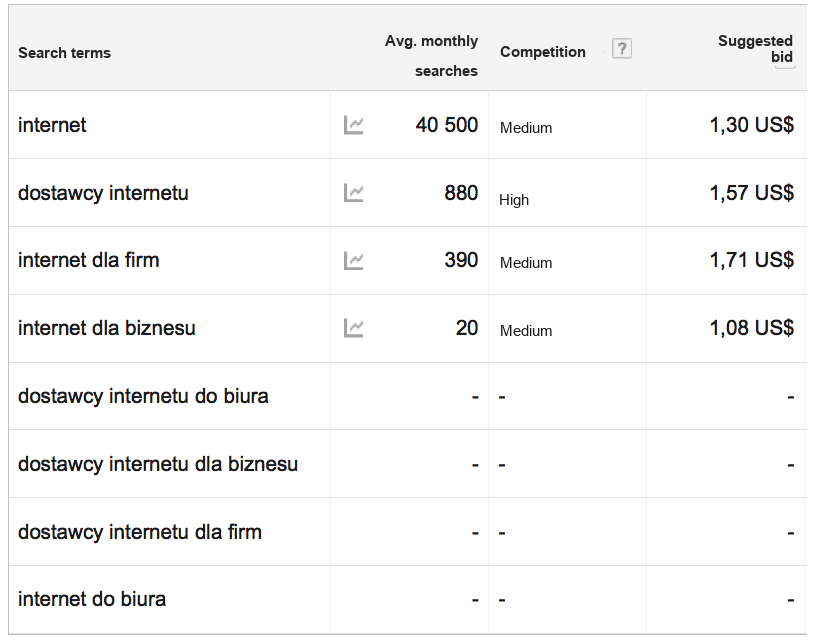
For example, a company offering telecommunications services for business, or, say, cheaper energy for offices, must reckon with the fact that for more generic keywords, a large share of people searching for “internet and phone providers” or “cheaper electricity” will be individual users. Only a very small share of queries will include the qualifier “for companies” or “for the office”.
A particular example of the problem of distinguishing a client from a consumer is the recruitment industry. Terms such as “employment agency”, “work agency”, “temporary work agencies” are searched both by potential clients and – above all – by people looking for a job. And although employment agencies also look for workers, the click cost will not necessarily be justified for acquiring a potential candidate. All the more so because keywords like “job offers” will be much cheaper.
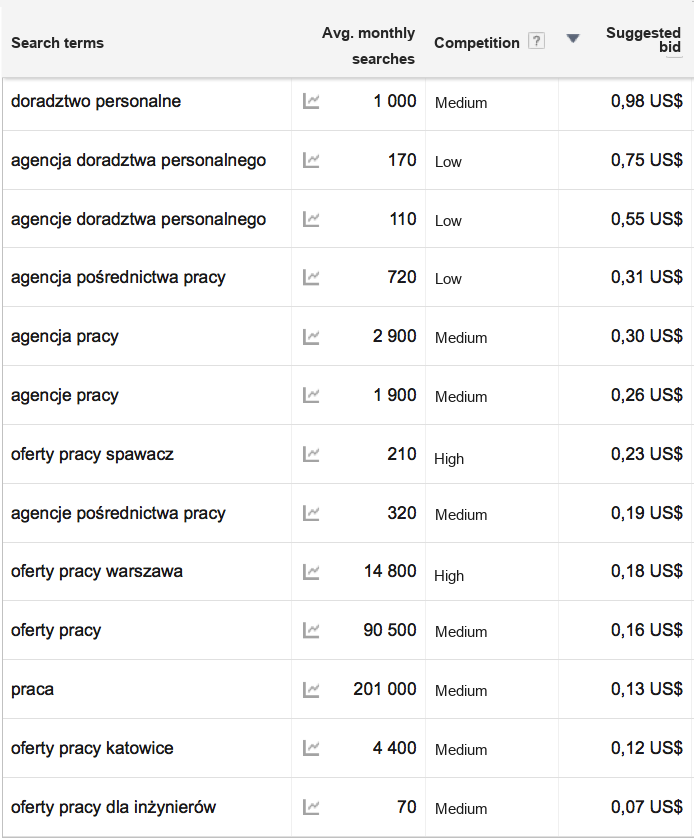
This is even more visible on the UK market, where the click costs of job- and recruitment-related keywords are – converted – in the range of €1-5.
Big business and corporations
Purchase decisions in big business and corporations are made in a very different way. In the 70s and 80s there was a popular saying: “nobody ever got fired for buying IBM”. And although IBM no longer makes laptops, the thought contained in that sentence is still valid. Decision-makers in large companies and corporations attach much more importance to the supplier’s reputation and financial credibility than to the quality of the offer itself, all the more so because they usually do not spend their own money. In the case of large companies, there will very often be a tender to which suppliers selected by the client will be invited.
But let’s not delude ourselves – the list of companies invited to submit an offer will rarely be created based on Google search results. It is rather doubtful that someone looking for a law firm to serve a large corporation would type “good law firms Warsaw” into Google. Decision-makers in large companies simply do not operate that way, also for self-protective reasons. In case of problems, explaining where this company came from – “from the Internet, they ranked high on Google” – may not sound too good…
Another issue is that decisions in large companies are made slowly. In many sectors, suppliers are not changed unless there is a real need. This is another reason why there will usually be relatively few large companies among those searching for particular services.
And although it cannot be ruled out that presence in Google search results will win a large client, based on our experience it must be said that the search engine will mainly deliver enquiries from smaller companies, which most likely sent a similar enquiry to several or even a dozen other companies that appeared in the search results.
Google Ads for B2B
Running Google Ads campaigns for B2B usually requires more work than typical campaigns aimed at the mass consumer. The click costs of keywords will often be quite high (after all, one client can mean tens or even hundreds of thousands in profit, sometimes millions). Search volume will be relatively small and, consequently, budgets will not be too spectacular.
Special attention should be paid to analysing the search terms report and excluding words indicating that the user is not a business customer. Classic examples here are the phrases “job”, “job offers”, “recruitment” – which are typical exclusions from this kind of campaign. Very often keyword analysis will require a good understanding of the essence of the advertiser’s business: which of the phrases “gas welding”, “TIG welding”, “MIG welding”, “GTAW welding”, “141 welding”, “plastic welding” is another name for the offered service (which may not appear on the landing page, if only because it is jargon), and which has nothing to do with the advertiser’s offer.
That is why an ads campaign should be run based on carefully selected keywords, accepting that in some cases the number of queries will be very small.
But even if there are very few Google queries for the advertised service, setting up an ads account will be useful for another reason – remarketing.
Brand-building activities
Taking the above into account, it should come as no surprise that B2B companies still invest considerable money in image-building activities, such as sponsoring industry conferences, display advertising on industry portals (often relatively expensive when counted in CPM or CPC terms), as well as TV advertising (especially on business channels). A few years ago, a company providing fracking services (related to shale gas exploration) hung a huge advertisement in Warsaw covering the entire wall of a dozen-storey building. The only explanation for such action may be that their potential client had its headquarters across the street…
Only big budgets?
Effective B2B marketing is not reserved exclusively for companies with huge advertising budgets. If a company cannot afford to sponsor a conference, maybe it is worth trying to prepare a talk? A substantive article for an industry magazine? Of course, entry barriers appear here too. That is why an excellent alternative to this type of activity is content marketing.
Content marketing
While we cannot always count on the media wanting to publish the materials we prepare – which even cooperation with the best PR agencies cannot guarantee – we can nowadays publish this content ourselves on the company blog or in the news section of the company website without the slightest problem, and then, with the help of appropriate social media promotion, ensure we reach the target group, often even much better than with traditional PR activities.
- When preparing content, we must remember that it does not have to – and in fact should not – be purely promotional. It also does not always have to be directly related to the offered product or service. What matters is that it can interest people from our target group. For example, a software provider for accountants will not necessarily create content exclusively about the offered software, its features and the benefits of using it. Rather, think about articles related to important regulatory changes, warnings about traps in the tax system, or ways to circumvent burdensome regulations or pay lower tax. Sometimes lighter topics can be covered, e.g. the results of industry sports championships. One thing must be remembered, though – this content must be interesting to our potential customers and rather uninteresting to people outside the industry.
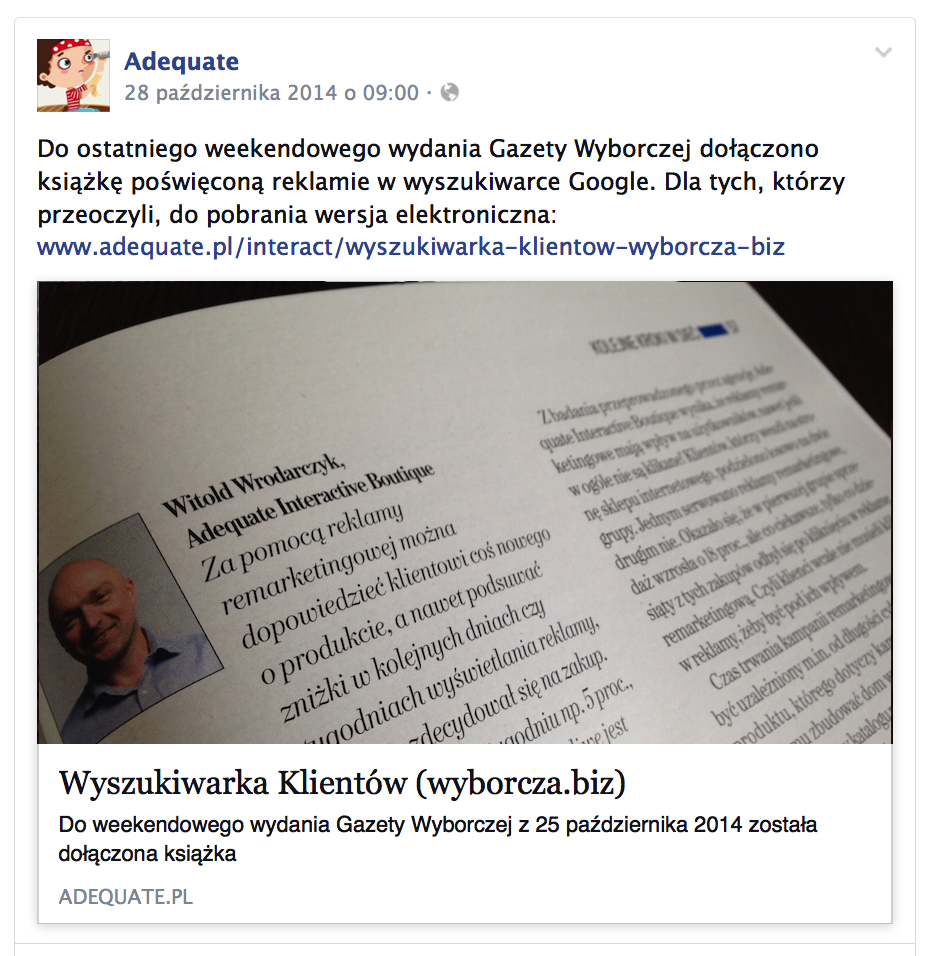
- We place the prepared content on our own website. It is important that information about the company and its services is visible on this page. Placing the content on a blog completely unrelated to the company website will not be quite optimal: after all, the point is not for the reader to get the impression that they are reading a news agency’s website. Once the user enters the page and reads the content, it is good for them to also know who delivered this content to them and what they potentially have to offer. If a given article or video appears in a reputable press publication, book or portal, it may then make sense to publish a summary on your own website and link on to the article or content. This way we increase the impact of the publication while leveraging the prestigious context of reputable media:
But don’t overdo the promotion – the advertising part comes later. It is important that the content is interesting and written competently, from the point of view of an industry expert.
3. Simply placing content on the website is not enough. We now have to make sure someone reads it. For this purpose, social media can be used by posting a link to the page with the promoted content on the company page (profile) on Facebook, LinkedIn and Google Plus. Why these social networks? They are sites that combine significant reach with the ability to run sensibly targeted post promotion campaigns. For services aimed at international customers, Twitter should also be considered. Other social media (Instagram, Pinterest) will rather not be useful in most B2B campaigns.
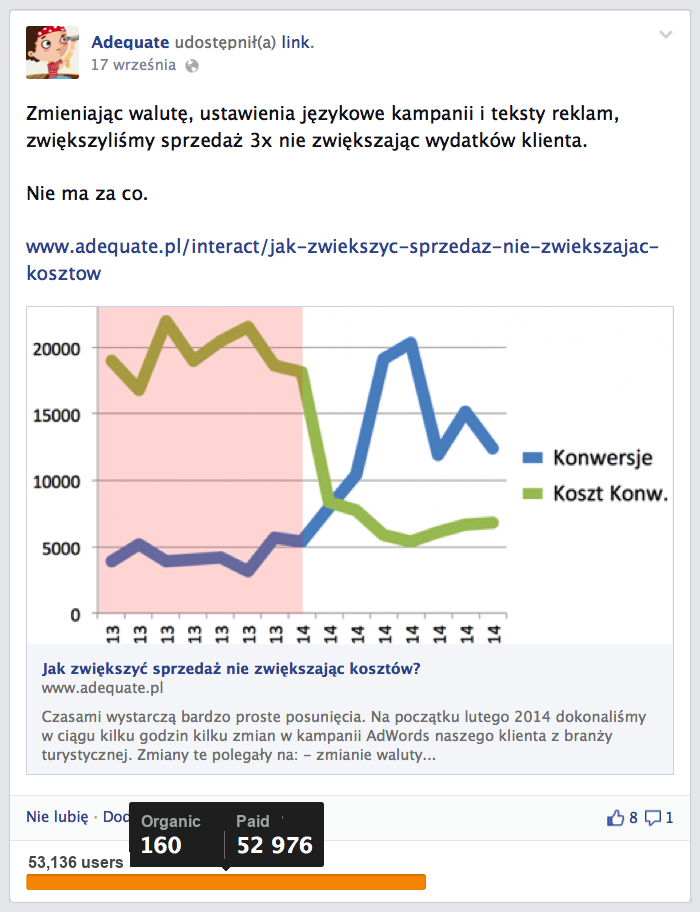
4. Content placed on a social network should then be promoted using the available advertising system. Why? Even if a company has a significant number of followers in social media, simply publishing a post ensures reaching only some of them (the organic reach of a Facebook post is usually less than 10% of fans). This is clearly visible in the difference between organic and paid reach in the Facebook post example below:
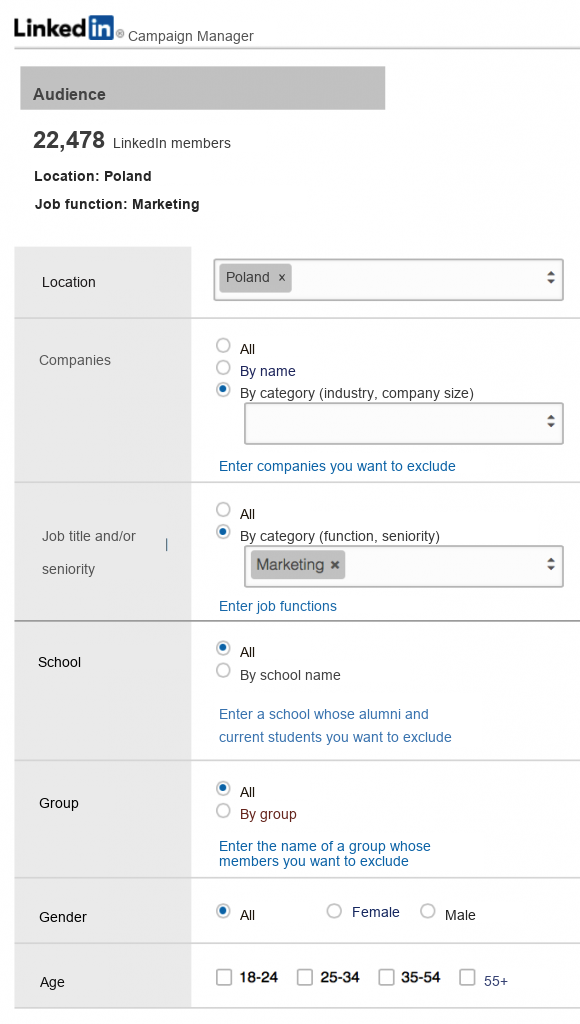
The situation is analogous on LinkedIn:

Moreover, let’s remember that our goal is to reach new potential customers and gain new fans/followers.
Using the advertising programmes of social networks, we can multiply the reach of published content. We are not afraid to put forward the thesis that, especially in B2B campaigns, with few exceptions, running social media activities without ad support – is pointless. The cost of preparing valuable content is usually quite high. Creating a substantive article, its proofreading, editing, publishing online and enriching it with appropriate illustrations and graphics – requires hours of qualified staff’s work, not to mention situations where the promoted content includes a video produced by a professional studio. The cost of promotion spend is usually much lower than the cost of preparing the content, and thanks to advertising, the number of people the content reaches – is multiplied.
For example, creating an article for a company with 5,000 Facebook likes took a total of 15 hours of work, which means a cost – according to internal billing – of €1,500. Publishing this article on Facebook without ads will achieve a reach of about 500 people. It is worth stressing that reach is understood as the post appearing at least once in users’ news feeds, which does not mean the post was noticed and read, let alone clicked and its content read. If we spend €500 on promoting this post, not only will we ensure it is displayed at least several times to each of our fans, we will also reach at least tens of thousands of new potential users. Increasing the cost by 1/3, we increase the reach more than a hundredfold.
The secret of effective promotion is properly selecting the target group: people who can potentially be buyers or otherwise participate in the decision-making process related to purchasing our products or services. Narrowing ad targeting to a limited target group will make it possible to achieve the goal within a reasonable budget. Here are our options in this regard:
(a) LinkedIn allows promoting a post based on very detailed criteria related to the user’s professional profile, allowing you to select location, company, job title, seniority level, function, age, gender, education, as well as membership in discussion groups (for example concerning related or competing products). LinkedIn’s main advantage is precise targeting and the prestigious, business context in which the promoted content will appear, and consequently, potentially higher effectiveness.
(b) Facebook offers targeting by demographic criteria and interests. Nevertheless, by creating custom lists, we can target for example by the user’s employer and job title, as well as by specific user interests. It is worth noting that the cost of advertising on Facebook, despite more difficult targeting and a non-business context, is much lower in CPM terms (cost per thousand impressions) than the cost of LinkedIn.
Advertising was also offered by the Polish business social network GoldenLine. Initially modelled on LinkedIn, it later transformed into a recruitment portal and – it seems – senior executives are now less likely to use it. The GoldenLine advertising system, although it allowed profiling the ad audience, was never as flexible and easy to use as LinkedIn’s. And while an analogous GoldenLine campaign would make sense as part of large-scale social media activities, in most cases it is not a medium worth reaching for first.
Remarketing
One of the most important foundations of B2B marketing is retargeting. People who landed on our website did not get there by accident: they must have somehow become interested in the content we publish. This interest indicates the probability that the user who visited the site belongs to the target group.
Thanks to social media activities, we bring to our website those people from the target group who, by clicking a link on a social network, indicated to us that they are interested in a given product or topic. Over time, we can accumulate quite a large group of users whose computer holds a cookie with information about a previous visit to our website.
We will be able to show remarketing ads to these people. Since this will be a limited group of people, the cost of such a campaign will be small. With a CPM (cost per thousand impressions) of around €1, the cost of displaying the ad on average 40 times (!) to each of 5,000 users will be €200. A retargeting ad can also take the form of a YouTube video.
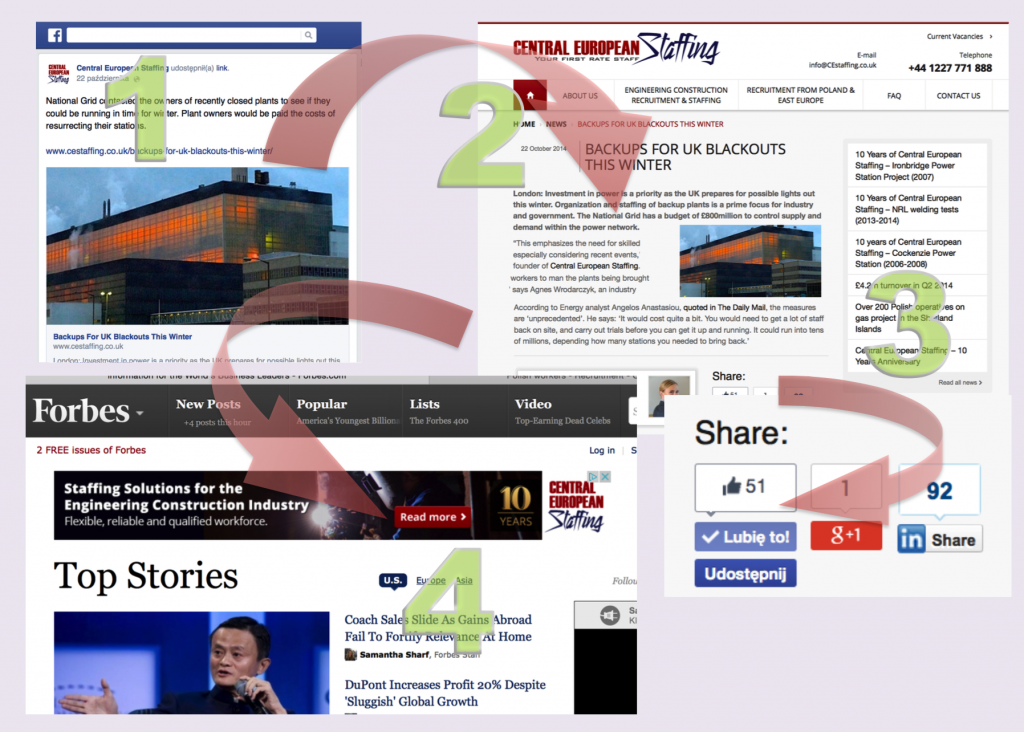
Social media activities therefore consist of the sequence:
- The user notices the promoted post on a social network.
- Being interested in the topic of the promoted content, they click the post and go to the page with the content (article).
- If they find it valuable, they will share it further, additionally strengthening the campaign’s impact (social recommendation).
- Based on the cookie, the user will see retargeting ads.
Precisely because of remarketing cost optimisation, there is not much sense in creating and promoting content that is interesting to the general public and bringing users from outside the target group to the website, since investing in retargeting aimed at lists of users outside the target group will simply be an unnecessary expense.
Newsletter
Finally, it is worth mentioning the possibility of using the traditional medium of email. If we are ready to deliver content regularly, it is worth allowing visitors to the company blog or news section to sign up for an email newsletter. Information about the possibility of subscribing to the newsletter should accompany the content on the blog or in the news section.
The newsletter can be used to notify interested users about a new blog post (article), as well as to send – within reason – promotional content. It is advisable for the newsletter to allow unsubscribing at any time.
