
The Omnibus Directive made waves across the European Union, and its provisions concern not only retail or e-commerce but also — as is often forgotten — advertising itself. The detailed rules for presenting prices and promotions are also regulated by Polish law. How do you implement them in practice, and what are the exceptions to the rule?
A few words about the legal basis
The rules stemming from Directive (EU) 2019/2161 of the European Parliament and of the Council, commonly called the “Omnibus Directive”, entered into force in Poland on January 1, 2023, introducing changes to, among others, the Act on informing about the prices of goods and services.
Art. 4 of that act contains the essence of correctly applying the “Omnibus” rules:
“In every case of announcing a price reduction for a good or service, next to the information about the reduced price, information about the lowest price of that good or service in force during the 30 days before the reduction was introduced shall also be displayed.”
The above rules also apply to online advertising.
You must therefore remember that any creative displaying a promotional price (e.g. in an ad, in search results, on the product page) must also state the lowest price in force during the last 30 days before the promotion.
For failing to comply with the information obligations regarding price reductions, a business can face a fine of up to PLN 20,000 imposed by the regional Trade Inspection authority.
If UOKiK (Poland’s consumer protection authority) finds that the practices infringe consumers’ collective interests, the company risks a fine of up to 10% of turnover from the previous year, and its managers — up to PLN 2 million.
How to present prices in advertising in line with Omnibus?
According to the guidance of UOKiK’s President, the information about the lowest price from the 30 days before the promotion must be displayed right next to the promotional price — i.e. it may not appear only on the landing page or in an expanded tooltip.
The obligation to reliably inform consumers about the price covers every place and every stage of the sale. This means that whenever we announce a price reduction for a specific good or service, we must also provide — in the same place and at the same time — the lowest price from the 30 days before the reduction.
The price must be described clearly and understandably, so the consumer has no doubt what the presented price refers to. UOKiK’s President explains that the exact wording “lowest price from the 30 days before the reduction” doesn’t have to be used — the information can be phrased e.g. as “lowest price from the 30-day period before the reduction” or “lowest price within 30 days before the reduction”.
What is improper, however, is using ambiguous phrasing such as “reference price”, “benchmark price”, “omnibus price”, “was”, or even “lowest price from the last 30 days”.
Example 1: When space is tight
A certain departure from this requirement is allowed when there’s no room for the full phrase “lowest price from the 30 days before the reduction” (e.g. in a mobile app). In that exceptional case you can use the shortened phrase “Lowest price”, explaining exactly what it means at a later stage or, for example, in an expandable note.

Example 2: A general announcement of a sale
For general sale announcements that can’t be assigned to a specific good or service (e.g. “rain boots up to -20%”), the information about the lowest price from the 30 days before the reduction should appear at the first — and every subsequent — moment when the reduction can be assigned to a specific good (e.g. on the product page of an item covered by the promotion).
Example 3: Lowering the regular price
Simply lowering the regular price (without announcing a promotion) doesn’t trigger the requirement to state the price from the last 30 days. The same goes for referring to prices in other sales channels or to a “recommended price”:

Which 30 days exactly?
When providing the lowest price from the 30 days before the reduction, remember that this doesn’t mean 30 days back from the day the user visits your website and views the offer, but the 30 days preceding the date the currently applicable reduction was introduced (see the chart below).

The lowest price from the 30 days before the reduction is the price you must always refer to. It’s also the reference point for calculating how much the user saves by taking advantage of the promotion — regardless of whether the benefit is expressed as an amount or a percentage. Using the chart above as an example, the savings from buying the product for 15 zł (calculated in line with the rules) equal 5 zł (because 20 zł – 15 zł = 5 zł), i.e. “you save 25%” — not 25 zł (40 zł – 15 zł = 25 zł), i.e. 63%.
Remember that even if the price kept changing, the reference point will always be the lowest price that occurred within the 30 days before the day the reduction was introduced.
Exceptions. When doesn’t Omnibus apply?
The guidance of UOKiK’s President lists situations of announcing a promotional price in which stating the lowest price from the 30 days before the reduction is not required. The exceptions concern, among others, “contextual advertising”, “upcoming prices” and “defective goods”.
Exception 1: Contextual advertising
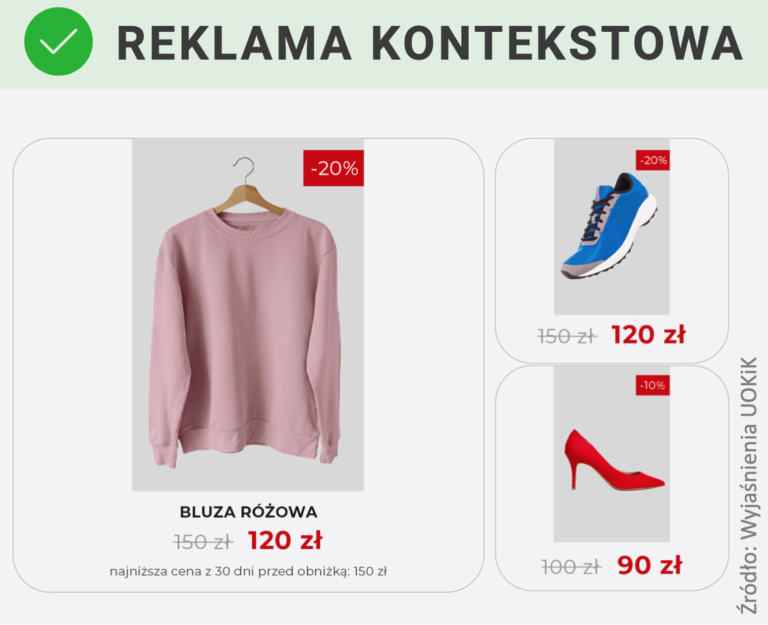
In contextual advertising, the main element of the creative can be used to correctly display the lowest price from the 30 days before the reduction, while omitting it in the remaining elements of the creative:
Exception 2: Upcoming price
For a product newly introduced for sale in a given store, a special way of presenting an attractive price offer can be used: juxtaposing the sale price with the upcoming price.
If the price offered from the start of sales is promotional (e.g. to mark the opening of a new store), and the price will rise after some time, this should be communicated understandably.
Logically, in this case you don’t state an earlier price or the price “from the 30 days before the reduction” — but you also shouldn’t label the upcoming price as the “regular price”, so as not to create the impression that the product was previously sold in that store at a higher price.

Exception 3: A general marketing message
UOKiK’s President points out that any slogans suggesting a promotion are considered “announcing a price reduction” (although the full context of the communication matters here).
General marketing messages such as “best prices”, “lowest prices”, “price hit”, “good price”, “attractive price” or their equivalents are not considered an announcement of a price reduction, provided that:
1. They refer to other price advantages, such as:
- The product’s price not rising compared with the competition,
- The product being hard to get or selling out fast, which makes it attractive,
- The product’s price being competitive in the market,
- The seller announcing a wide range of products at attractive prices,
- The seller offering other favorable sale terms besides the product’s price.
2. They are not intended to circumvent the price information act.
3. The prospect of other price benefits is understandable to the consumer.
4. The marketing communication specifies the kind of benefit the seller is invoking.
Exception 4: “Multipacks” and perishable goods
Conditional or bundled offers are not subject to these regulations (e.g. “multipacks” or “2+1” promotions), as long as no price reduction for a specific good is announced. For an offer like “spend 150 zł and get a 10% discount on your next purchase”, there’s no need to state the lowest price from the 30 days before a reduction, since no reduction of a specific good’s price is being announced. But watch out for offers like “buy any products for 100 zł and get -10% on (a specific) product X”.
For goods that spoil quickly or have a short shelf life, next to the current, reduced price you display the price from before the first reduction was applied. You don’t state the lowest price from the 30 days before the reduction in that case.
Exception 5: Defective goods and goods nearing their use-by date
A product of lower value (e.g. from display, damaged, returned by a customer in non-original or damaged packaging) can be treated as different from a full-value product — which the business should clearly communicate.
A similar approach can be applied to products approaching their use-by date (which are not fast-spoiling goods). Incidentally, the period during which such a product remains usable shouldn’t exceed 7 days. It’s permitted to encourage customers to buy such a product by lowering the price, without directly announcing a reduction. In that situation there is no obligation to state the lowest price from the 30 days before the reduction.
Exception 6: New to the range
For products that have been in the range for less than 30 days, you state the “lowest price since the product’s introduction”.
Likewise when a product is withdrawn from the range for longer than 30 days. When it is reintroduced, any promotions run within the first 30 days should include information about the reduced price and about the lowest price in force since sales resumed.
Discount codes and loyalty programs
In practice, businesses often use discount codes (online or as physical coupons) to offer price reductions. Codes may also be distributed to consumers through influencer partnerships or in connection with customers’ participation in loyalty programs.
Codes can be general (like those published on a website — example below) or individual (offered to customers e.g. for their next purchase).
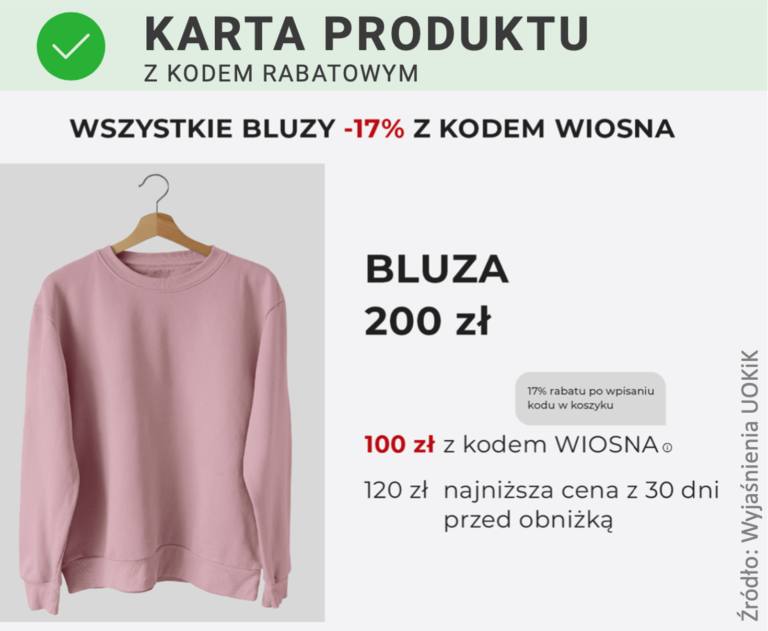
For discount codes referring to a specific good (or group of goods), the lowest price from the 30 days before the reduction must be stated.
The obligation to state the lowest price from the 30 days before the reduction does not apply to discount codes, as long as they don’t refer to a specific product.
When, say, an influencer announces a reduction on a specific product with a code, they should also state that product’s lowest price from the 30 days before the reduction. Regardless, the online store offering the products promoted by the influencer must provide the lowest-price information no later than immediately after the buyer applies the code.
It’s similar with loyalty programs offering a general discount (e.g. a discount “on everything”) or personalized offers (e.g. a discount code for a specific product emailed to program members). Both cases must be treated as announcing a price reduction, and the lowest price from the 30 days before the reduction must be stated.
However, when participation in a loyalty program provides a general discount on unspecified goods or services, or on products freely chosen by the consumer, there is no obligation to state the lowest price from the 30 days before the reduction.
Cart-level codes
It’s worth distinguishing codes “for everything” from so-called cart-level codes. The former cover all (i.e. specified) products during the promotion, requiring the lowest-price-from-30-days information (next to every product). A cart code, entered at checkout, doesn’t require that information next to the product, because it’s the consumer who only then defines the order. Even so, offering frequent codes for subsequent orders may be seen as an unfair market practice, similar to an “everything” promotion.
Shopping ads and the product data feed
The Omnibus Directive also governs how price reductions are communicated in ads — and Shopping ads in Google Ads are no exception.
Sale price annotations
Google displays Shopping ads based on the data submitted in the product feed, where price is handled by the [price] attribute. If a [sale_price] attribute is set for a product, that price will be displayed as the product’s price.
Google checks that the prices offered in the product feed match the landing page, and if it detects a mismatch it won’t display the ad.
When the current [sale_price] is lower than [price], Google may display the product with a SALE badge. The [price] attribute will then be used to show the pre-reduction price, struck through, as on the first product from the left:
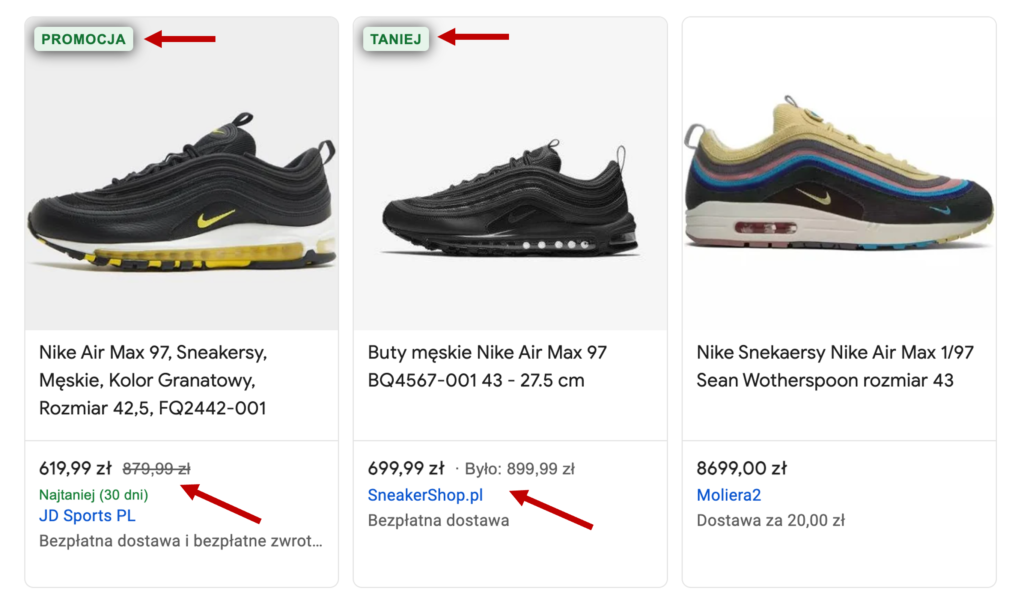
Notice that these ads carry the annotation Najtaniej (30 dni) — “Lowest (30 days)” — showing that the presentation of this price has been adapted to the Omnibus Directive’s requirements (within the space available in this ad format).
For this reason, to display Shopping ads in line with the Omnibus Directive, during a price reduction the [price] field should contain the lowest price from the last 30 days before the reduction was introduced — not some other reference price. The current price goes into [sale_price].
The details of the algorithm that decides whether to switch on the SALE badge are not disclosed by Google.
In the past, Google Ads help articles specified a requirement that the product be offered at the reference price for no less than 30 days within the last 200 days, that the reduction be between 5% and 90%, and that it last no longer than 30 days. As of today (February 2024), this information is not in the documentation.
It can be expected that Google also checks displayed reductions for Omnibus compliance, and entering a reference [price] in the feed that’s higher than the lowest price from the last 30 days before the reduction will likely prevent or reduce the chance of the SALE badge appearing — and if it did appear anyway, it would violate the Omnibus rules.
Price drop annotations
Google’s algorithm can also notice on its own that a price is lower than in the past, even if we don’t provide it in the [sale_price] attribute. Google may then add a PRICE DROP annotation to the product, as with the middle product in the illustration above (see also the Google help article).
It may happen that Google marks as PRICE DROP a product the seller offered at that price within the 30 days before the current reduction (Google may simply not know about it). This can raise some controversy under the Omnibus Directive.
Currently (February 2024) we’re seeing ads with the PRICE DROP annotation leading to product pages showing only the current price (it isn’t communicated as a price reduction).
The advertiser has no influence over whether this annotation appears.
It’s possible this mechanism will evolve.
Automated discounts
Google is also introducing an automated discounts feature, in which Google itself decides to lower a product’s price if that increases the chance of a sale and of higher profit for the advertiser. The advertiser merely declares the minimum price they’re willing to sell the product for [auto_pricing_min_price].
This feature integrates the site’s content with the ad — after an automated reduction, the product’s price is also changed on the seller’s site.
Reductions are applied individually when the ad is displayed, and after clicking through to the landing page the price must remain valid for at least 30 minutes. If the item is added to the cart, the price must be maintained for 48 hours.
The automated discounts documentation currently (February 2024) doesn’t address Omnibus Directive compliance. The feature presently presents the product’s price relative to the current price (a reduction message and the “old” price struck through).
The guidance of UOKiK’s President (file downloadable from the UOKiK site) states that when a price is individually adjusted based on automated decision-making, the lowest price from the last 30 days before the reduction must also be provided.
Since the “before” price in this feature is the current price, you should avoid presenting reductions for products that were sold within the last 30 days at a price lower than the current one — because then the reference price wouldn’t meet the Omnibus Directive’s conditions.
The advertiser can exclude a given product from automated price reductions by not setting the [auto_pricing_min_price] attribute for that product.
Before using this feature, it’s worth seeking legal advice, particularly on how the lowest price from the last 30 days before the reduction is calculated.
Note also the obligation to inform a person intending to buy a product about individual price adjustment based on automated decision-making — an obligation stemming from the Polish Consumer Rights Act.
Regular promotions
Many stores use regular promotions as part of their strategy. Their schedule is often planned long in advance and woven around holidays and other occasions such as Valentine’s Day, Children’s Day or Mother’s Day.
In that situation, make sure the periods between promotions are no shorter than 30 days:

If we want to run promotional campaigns more often, we have to do it for different parts of the range. E.g. shoes on sale now, sweaters in two weeks, trousers two weeks after that.

At least 30 days should pass between promotions of a given product.
This doesn’t mean prices can’t be lowered in the meantime. We can change the price as we see fit, but in that situation we won’t be able to communicate the latest price change as a reduction.
In the example below:
- The first time, 30 days had passed since the last reduction, so it can be communicated as a price cut from 100 zł to 80 zł (-20%).
- Before the second reduction there was no 30-day “break”, so even though we lowered the price from 100 zł to 70 zł, we can’t communicate it that way — at most we can say the price was reduced from 80 zł to 70 zł (-12.5%).
- Before the third reduction there was again no 30-day “break”, so even though we lowered the price by 10 zł, we can’t communicate it, because the lowest price from the last 30 days before the reduction is higher.

In this last situation, communication highlighting the offer’s attractiveness is sometimes used, e.g. GOOD PRICE or BARGAIN. But remember that such an offer’s communication must not mislead, and taken as a whole it must not lead the consumer to read it as an announcement of a price reduction.
Similarly, caution is needed when, besides the 30-day price, we also mention a “regular price” (“recommended price”, “manufacturer’s price” etc.). Such information must not mislead the consumer into thinking the current reduction refers to the “regular price”.
This applies in particular when we’ve reduced the price from the “regular price” to the current promotional price, but had the same price as today in a promotion, say, 2 weeks ago (within the 30-day window). Referring to the regular price in that situation may suggest there’s a price reduction, whereas under the Omnibus rules we cannot speak of a reduction. The very purpose of this regulation was to prevent sellers from briefly raising prices just to be able to announce reductions.
When in doubt, seek legal advice.
