
It is said that winning a new customer is several times harder than selling a product to an existing one. This principle also matters a great deal in ad optimisation.
Because existing customers are easy to reach, it is often recommended to target various sales activities, including advertising, precisely at them in order to get quick and significant results. Nevertheless, excessive focus on returning customers can limit the inflow of new customers and produce the opposite of the intended effect.
In the traditional approach to measuring advertising effectiveness, every customer transaction (the first and subsequent ones) is treated the same, and effectiveness measured by ROAS simply relates revenue to advertising costs.
But since acquiring a new customer is harder, in such a situation the optimisation algorithm will prefer to invest where it wins returning customers, which gives it higher efficiency, at least in the short term. In the longer term, however, this can limit the inflow of new customers and consequently lead to stagnation and declining sales.
Optimisation strategies for new customer acquisition in Google Ads
That is why Google introduces strategies aimed at acquiring new customers. They have two modes:
- Bid for new customers only – in this case the campaign goal is exclusively a purchase by a new customer, and the algorithm will try to reach only people who have not bought before.
- Bid higher for new customers – this increases the chances of reaching new customers, because the bonus (additional conversion value) for new customers compensates for their lower conversion rate compared to existing customers.
In both of these modes, conversions will include both new and returning customers’ conversions (they will affect CPA and ROAS). In particular, a campaign targeted exclusively at new customers may also generate returning customers, because it is not possible to fully prevent ads from being shown to existing customers. These returning customers will also be reported as conversions, along with their value.
The higher-bids-for-new-customers strategy also makes it possible to differentiate the value of new customers and to treat some customers as lost, which justifies spending more to win them back. These are the features:
- New customers (high value)
- Inactive customers
- Inactive customers (high value)
These features also allow you to assign these customer segments additional value relative to “ordinary” returning, loyal customers.
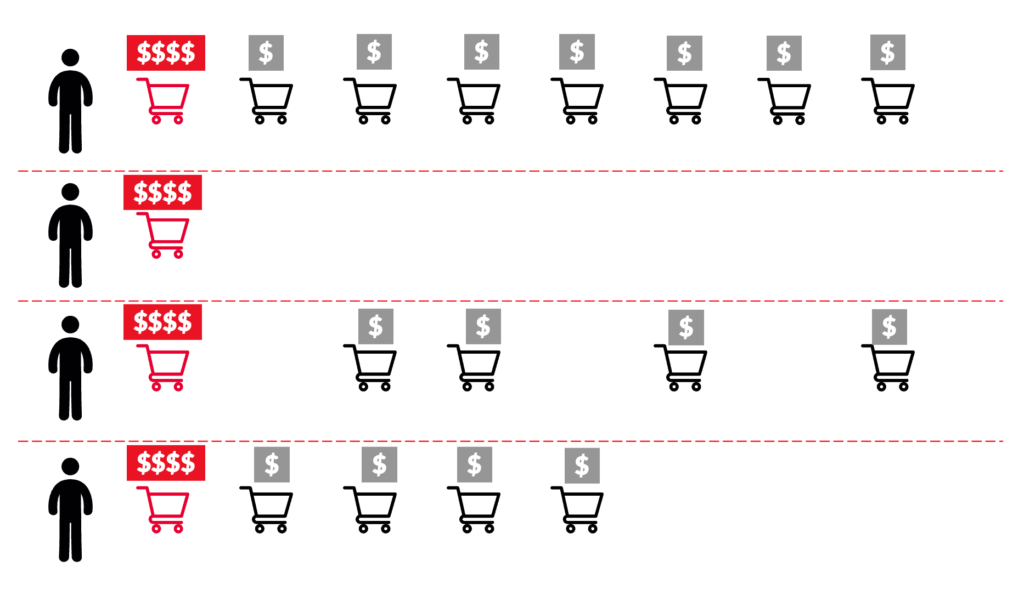
How does Google Ads know it’s a new customer?
For these strategies to work, Google must know whether a given customer is buying for the first time or whether it is their next purchase. Google tries to determine this based on conversion tracking, which uses cookies. However, this measure is inefficient and struggles to recognise a new customer. Therefore, apart from automatic new customer detection, we have two more ways to enrich Google Ads data with 1st party data:
- Uploading a customer list (sending Google the email addresses and phone numbers of existing customers)
- Marking the conversion with the new_customer parameter. This requires exposing it in the data layer and including it in the tracking code configuration in Tag Manager (if you don’t use Tag Manager, this value should be generated dynamically directly in the tracking code). In server-side setups, it is possible to create a module that performs this task without touching the website code.
Failing to implement the new_customer variable will probably inflate the number of new customers and inflate ROAS, because based on remarketing lists and customer lists you can only identify a returning customer, but you cannot say with certainty that you are dealing with a new one.
More information about configuring new customer tracking in Google’s help article. You will also find there a link to a tutorial video helpful for the configuration.
The inactive customer and high-value customer features rely exclusively on customer lists (email addresses and phone numbers).
While the inactive customer features are based directly on audience lists indicated as lost customers and lost high-value customers (a kind of remarketing list), the new high-value customer acquisition feature consists in looking for potential new customers similar to current high-value customers (lookalike targeting).
The assessment of whether a given new customer is potentially a high-value customer is therefore arbitrary (at the moment of acquiring a new customer we do not yet know their long-term value). So we have no control over which new customer will be deemed potentially high-value and consequently assigned a higher value than other new customers.
For this reason, the high-value new customer feature should be used with caution; you should check whether Google is not assigning high value to too many new customers, and correct the ROAS target accordingly. Especially since it is impossible to verify whether these customers really generate higher value later, due to the lack of reporting of individual transaction IDs.
Reporting customer lifecycle results in Google Ads
If we enable customer lifecycle goals in Google Ads campaigns (new customer acquisition, win-back of lost customers), new metrics and segments will appear. Segmenting the reports (Conversions > New vs. returning customers) we will see the following breakdown:

Unknown – means Purchase conversions for which it was impossible to determine whether we are dealing with a new or returning customer. The causes may be related to limitations such as lack of user consent. It can also result from configuration errors (see Google’s help article). You can read how to try to deal with this later in this article.
Additional conversions (all customers) – conversions that are not Purchase conversions. For these conversions, in campaigns using higher bids for new customers, customer lifecycle segmentation (new/returning/won back etc.) is not available. They concern “all customers”.
The New customer lifetime value column shows the amount of additional value assigned to acquired new customers (the one we defined in the goal settings).
The names of the remaining columns and rows are self-explanatory. In campaigns with a lost customer win-back goal, we will also have the segments won-back customers and won-back customers (high value) available.
ROAS is now CAC vs. LTV
Optimising with a new customer acquisition goal means a fundamental change in measuring effectiveness.
ROAS, understood as the relation between revenue and advertising cost, is replaced by the relation between LTV (Lifetime Value) and CAC (Customer Acquisition Cost).
When calculating advertising effectiveness in LTV vs. CAC terms, however, you must account for the future costs of retaining the customer (the costs of selling to returning customers), as many times as there are returning customer transactions within the LTV.

How to calculate LTV?
LTV means the value of all the customer’s transactions, now and in the future.
The period over which we determine LTV can be arbitrarily long (although for biological reasons it will not exceed 100 years). It should not be longer than the investment horizon of the company and its investors, because all LTV-related analyses are based on the assumption of achieving a return within the considered period. In practice it is usually 2-3 years. Its length will also be affected by the specifics of the product, purchase frequency, and actual customer loyalty.
For example, for car brands you should think in longer periods: customers replace cars every few years, but since they use the product daily, we can count on their attachment to the brand.
Calculating LTV over a period shorter than 1 year may cause it to be underestimated, because competitors may look at advertising investments over a longer horizon. Therefore LTV should be calculated over longer periods, unless we know that the entire customer lifecycle really closes within a shorter period.
When estimating expected LTV from historical data, remember that calculating it does not mean dividing the sum of revenue in a given period by the number of customers.
The proper methodology is cohort analysis, i.e. selecting a cohort of users who became customers in a chosen period and determining the transactions of customers from that cohort in later periods.

GA4 can help with this analysis; such analyses can be performed there for periods of up to 50 months (up to 14 months in the free version).

Note! The condition for the reliability of this data is feeding the report with 1st party data, i.e. a User ID in the form of the user’s hashed email address (or another identifier). Otherwise, the cookie-based analysis understates LTV.
Unfortunately, as of the date of updating this article (20.12.2023), Analytics cohort reports do not include User ID data (the annotation “Based on device data only” in the top right of the report), so implementing User ID will not improve their quality.
When doing the calculations, let’s distinguish revenue from margin. If we calculate LTV based on revenue, remember that it is not entirely profit on the sale, because we must subtract the direct costs of purchasing or manufacturing (excluding fixed costs). The purpose of these calculations is to determine how much more money the company will have thanks to the customer’s next transaction.
For multi-year periods, the analysis should take into account the time value of money. Income in the distant future should be discounted to determine its present value. Nevertheless, in many cases product prices will rise in the future, so these factors will offset each other and an analysis in today’s prices will be sufficiently accurate.
How to set conversion values in “new customer” campaigns?
The key to setting these goals is determining how much harder (more expensive) it is to acquire a new customer than a returning one. Unfortunately, it seems this has to be set arbitrarily, because it is hard to point to an unambiguous measurement method.
One indicator can be a comparison of the conversion cost in campaigns targeted at existing customers versus campaigns targeted at other users. You can also compare direct sales statistics: how often a sales conversation ends in success with existing customers vs. people buying for the first time. This number, let’s call it k, should probably be in the range of 5 to 10.
The next value to determine is LTV and how many purchases it consists of on average. For example, calculating LTV over a two-year horizon, we estimate that it consists of n = 5 purchases of €300 each, so LTV is the value of 5 transactions, i.e. €1,500.
So we have the following variables:
n – the number of transactions making up the LTV
k – how many times harder it is to acquire a new customer compared to a returning one
V – transaction value
Vret – the “value” of a returning customer’s transaction
Vnew – the “value” of a new customer’s transaction
By definition:
Vnew = kVret
and
LTV = nV
With different treatment of the value of a new and a returning customer, they must add up to the same LTV, therefore:
LTV = Vnew + (n-1) Vret
Combining these two LTV formulas:
nV = kVret + (n-1) Vret = (k + n – 1) Vret
So

In a system where a bonus is added to a new user’s conversion, we report every conversion (including a new customer’s) at the returning customer’s value, and for new customers the system will additionally add a bonus worth:
Bonus = Vnew – Vret = kVret – Vret = Vret (k -1)
So

Implementation in practice – higher bids for new customers
Changing the transaction value V to the values Vnew and Vret for new and returning customers respectively means increasing the transaction value for new customers and decreasing the transaction value for returning customers.
Example. If the LTV consists of 5 transactions, and a returning customer is 6x easier to acquire than a new one, then according to the model described above:
Vnew = V × 3
Vret = V × 0.5
Bonus = V × 2.5
If the assumptions changed, this would mean changing the values of these multipliers for individual conversion types. This would require modifying the tag settings each time.
Note also that Performance Max campaigns assume a fixed bonus value for the new customer (it does not depend on the value of the first transaction). In the example described above, if the average transaction value V = €100, the new customer bonus will be €250.
That is why it will presumably be simpler to leave the transaction value as it was reported so far. This will mean, however, that the transaction value of returning customers will be overstated. But if we also increase the new customer bonus and the target ROAS by the same factor – the campaigns will pursue the same assumptions.
In our example, if we do not change the values of returning customers, they will be overstated twofold (1 / 0.5 = 2). So if we also double the target ROAS and the new customer bonus – we will achieve the intended effect.
For campaigns other than Performance Max, you can then create an additional new customer conversion with that value multiplied by the bonus multiplier. You just have to remember that the reported conversion values are overstated by a constant factor and therefore the target ROAS must also be higher by that factor.
Note – on some accounts the option to set the new customer goal has already appeared for campaigns other than Performance Max.
Let’s assume that in our example ROAS was supposed to be 10. If we leave the values of returning customers unchanged (which in this example means a twofold overstatement), the new customer bonus (which we also have to double) will have to be €500, and the campaign’s target ROAS will also have to be set twice as high, i.e. 20.
In Performance Max campaigns assigning higher value to new customers, we enter this bonus in the appropriate field of the campaign settings.
In other campaigns, we add an additional conversion to the campaign’s optimisation goals and assign it a fixed value equal to the new customer bonus (after applying the multiplier).
In this spreadsheet (Excel) you can perform the necessary calculations.
Implementation in practice – acquiring new customers only
For campaigns outside Google Ads, where it may not be possible to target a conversion set, a sensible solution may be to optimise exclusively for new customer conversions, if we do not want to modify conversion values in tags.
Note. Google Ads campaigns with the “new customers only” goal also report returning customers as conversions, so this paragraph does not apply to them.
In this case, you will also need to modify the campaign’s ROAS or CPA target if we leave conversion values at the same level. What multiplier should apply here?
By definition, the campaign’s actual ROAS is:
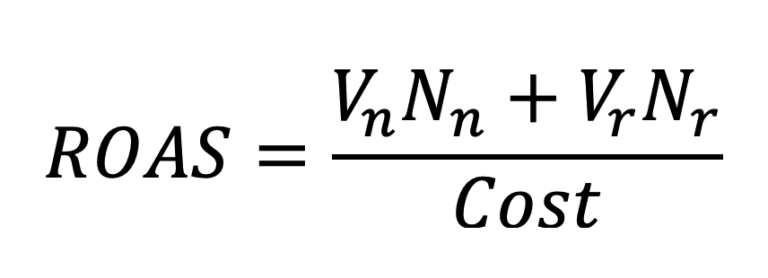
Where Vn and Vr are the conversion value of a new and returning user respectively, Nn and Nr are their respective numbers, and Cost is the total campaign spend.
In turn, the ROASm that we measure in such a campaign is

Where V is the measured conversion revenue value. Combining these equations, we get the ratio of actual to measured ROAS:
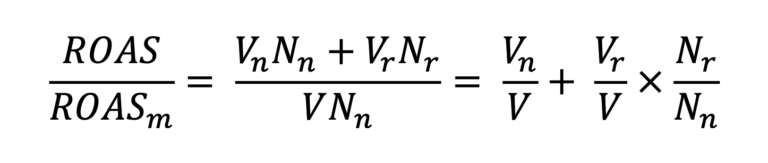
It depends on the new and returning customer multipliers and the ratio of returning to new customers from a given campaign.
As long as the campaign does not generate many returning customers, due to their lower value, the factor resulting from the share of returning customers can be omitted:
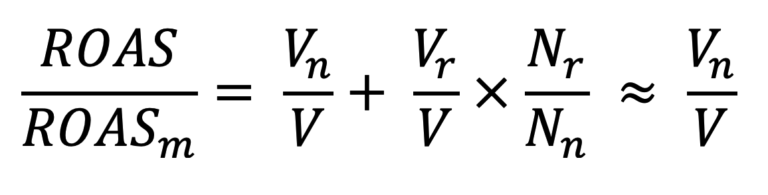
Any corrections should only be introduced when the share of returning customers becomes significant, and once a correction is made, it does not have to be modified with every small change in the share of new customers in the campaign’s conversions.
In our example, where the assumed ROAS = 10, for a new customer goal campaign that generates 1/3 returning customers (i.e. for every 2 new customers there is 1 returning customer, so Nr/Nn = 0.5), the campaign’s target ROASm should be 3.08.
Ignoring the influence of the returning customer share, ROASm would be 3.33, so the difference is not large.
However, if there were 6 returning customers per 1 new customer, i.e. the “side effect” of this campaign were significant, accounting for it in the goal would mean ROASm = 1.67.
Caveats
The models described here contain a number of simplifications, including:
The assumption that since the costs of acquiring a new customer are k times higher than a returning one, their “value” will also be k times higher. This de facto assumes the same ROAS for acquiring a new and a returning customer, which is not necessarily optimal.
Google assumes a fixed new customer bonus value, which means that LTV does not depend on the value of the first transaction. In reality there may be some relationship between the value of the first transaction and LTV.
Similarly, a strategy bidding exclusively for new customers with a CPA goal assumes a fixed customer LTV (regardless of transaction value), and a ROAS strategy bidding exclusively for new customers assumes a linear relationship between LTV and the value of the customer’s first transaction.
It was assumed that the transactions of new and returning customers have the same average value. In fact, the basket value of returning customers is often higher than for first transactions.
The resulting nuances may cause the models to deviate to a greater or lesser extent from real processes.
