
Google Ads advertising is sold through an auction system, and the price an advertiser pays, as well as the ad’s position, are determined in real time by an algorithm that takes into account the price offered by the advertiser and the competition from other advertisers.
The Google auction, however, is not a simple “highest bidder wins” affair.

Ad Rank
Whether an ad will show at all, and what its position will be relative to other ads, is decided by Ad Rank, recalculated every time an ad becomes eligible to show — that is, whenever it meets the conditions defined by its targeting (for example, a user searched Google for a phrase that matches a keyword in a search campaign). See also Google’s help article on Ad Rank.
The ads of all advertisers who qualify for the auction are ordered by Ad Rank, and this ordering determines whose ad will be shown.
Ad Rank is made up of two factors: the price offered and the quality of the ad. In simplified terms:
[Ad Rank] = [Bid] x [Ad quality]
The bid
The bid is the maximum cost per click the advertiser is willing to accept. These days advertisers very rarely set maximum CPC bids directly, and many campaign types don’t even offer manual bidding. In most cases, the bids an ad enters the auction with are calculated based on the goal defined in the bidding strategy (smart bidding).
The algorithm computes the bid from the goal it was given (e.g. a target cost per conversion) and from its own predictions about the ad’s expected performance (e.g. the expected conversion rate).
For example, if the target cost per conversion is €150 and the algorithm predicts that a given ad can be expected to convert at 1%, then the maximum price it will be able to offer in the auction is €1.50 = 1% x €150.
Keep in mind that the bid is not the price actually paid — the actual price will always be equal to or lower than the bid. Moreover, the algorithm may sometimes decide to offer a price higher or lower than the one implied by the campaign goal, because the campaign’s goal is to achieve a certain average cost per conversion (so for some keywords it will be higher, for others lower).
Ad quality
The Google auction is not based on the bid alone. When determining an ad’s position, Google takes its quality into account. Google states that quality depends, among other things, on how relevant the ad text is to the search, how likely users are to click the ad, and the quality of the landing page experience.
To better understand how this mechanism works, you need to realize what it is for. It serves to maximize Google’s short- and long-term profits.
Does Google care about our clicks?
It is worth understanding that from Google’s point of view, clicks on ads are of secondary importance.
Google’s goal is to maximize the profit earned from advertising, i.e. from selling ad space — and that ad space is the search results. This space generates a certain number of impressions (the number of searches), and the point is to sell it at the highest possible price.
Advertisers prefer to pay for a more tangible, verifiable effect, which is why they are far more willing to pay for clicks than for impressions. For this reason, at the very beginning of its advertising program Google abandoned the CPM model and daily rates, and introduced pay-per-click billing (CPC — Cost Per Click).
At the same time, a mechanism was built into the auction whose main job is to raise the price per click for ads that generate fewer clicks.
The main short-term goal of the ad quality mechanism is to raise CPCs for ads that get clicked less often.
The math here is simple: from Google’s profit perspective, it makes no difference whether an ad gets clicked 10 times per 100 impressions (CTR = 10%) at a CPC of €2, or brings 20 clicks per 100 impressions (CTR = 20%) at a CPC of €1.
In both cases, the advertisers who appeared across 100 impressions of ad space will pay €20. So one could say that although advertisers pay for clicks, they are effectively paying for impressions.
As a consequence, the higher the CTR, the lower the cost per click.
Keep in mind that what matters is the relative CTR at a given position. In absolute terms, CTR is as a rule always higher for ads placed in more prominent spots, high above the search results. That’s why comparing the CTR of an ad in position 1 above the search results with the CTR at the bottom of the page makes no sense — hence Google analyzes the relative CTR at a given ad position.
User experience matters
Another aspect of ad quality is user experience. Is the ad interesting to the user, and does the place they land after clicking match their expectations?
Underlying this mechanism is the assumption that long-term profits from search advertising depend to a large extent on the quality of the user’s experience when clicking ads.
If ads don’t match what users are looking for, over time users will start avoiding clicking on ads. Ads will then be worth less to advertisers, and advertisers in turn will be unwilling to offer higher prices and increase budgets. This is why ad quality also takes into account how well the ad itself and the page content answer the user’s query, and what the experience on the landing page is like.
Ad relevance, i.e. how well the ad content matches the query, is measured primarily through… CTR. An ad that gets clicked more often most likely answers the user’s query better. Google may well apply some adjustments here, but clickability is certainly one of the most important signals.
Assessing landing page quality (i.e. the user’s experience of using it) is a more complex task. A large part of the factors behind this assessment is a Google trade secret, around which many myths and unverifiable hypotheses have grown. Google officially debunks some of them in the Google Ads help article on ad quality and the Google article on the factors that affect ad quality. Ad quality is not affected by:
- the bid and your spend with Google
- conversion rate
- account structure
What can make ad quality worse:
- a slow-loading landing page;
- page content that matches neither the ad nor what the user searched for (the search term);
- a page that is not mobile-friendly;
- a page that is hard to navigate.
Bear in mind, though, that quality is not simply the presence of the keyword on the landing page or how fast the site loads. It is rather the big picture — a holistic assessment of the page’s quality compared with other pages in the search results.
You should assume that this mechanism is above all there to eliminate low-quality pages — pages that malfunction or manipulate the user.
Google doesn’t want the keyword “best cars” to trigger an ad saying “Beautiful women are waiting for your call” that leads to an online casino when clicked. If ads looked like that, users would eventually stop clicking them. From Google’s perspective, in the long run it simply wouldn’t pay off.
Quality Score
Quality Score is a diagnostic metric that estimates ad quality and can serve as a hint for improving your ads. Remember, however, that ad quality is computed in real time for every auction, and Quality Score itself is not a ranking factor and is not used in the auction.
In other words, the expected and actual quality of an ad will influence its Quality Score, but these reported measures do not influence quality. You should not optimize Quality Score at all costs.
See also the Google Ads help article on Quality Score.
Want a lower CPC? Think CTR!
Despite the many nuances, ad quality — the key factor affecting your cost per click — depends to a great extent on CTR. This is perfectly illustrated by an example showing how an ad’s CPC changed after changes that increased its CTR:
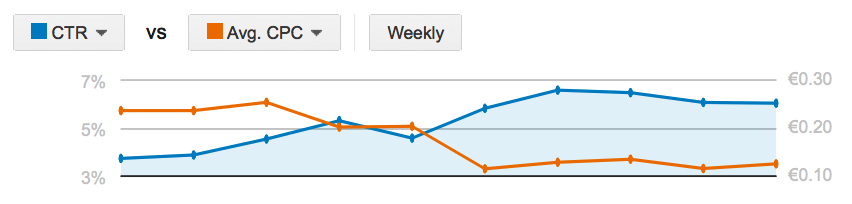
The ad’s clickthrough rate grew 2–3 times (from 2–2.5% to 5–6%), which brought the CPC down 2–3 times (from €0.25–€0.30 to €0.11–€0.15).
Simply put: the higher the CTR, the better.
Advertisers sometimes worry that an ad that provokes clicks will increase their costs — “let it show, but let them not click.” That’s flawed thinking. Extra clicks will only lower the price we pay per click in the future, and in the long run we won’t incur any additional costs just because there were more clicks.
Increase CTR — but not at all costs
Of course, clickability isn’t everything. A deceptive ad text may attract plenty of misled users, but will they convert? And won’t it, down the line, put off the people who actually wanted to buy what we really offer?
Can an ad placed in a completely irrelevant spot — one that attracts clicks by imitating system buttons, or that sends to the landing page a user who clicked an [x] button suggesting it would close the ad — deliver meaningful traffic despite a very high CTR?
On the other hand, if an ad promises slightly more than the landing page actually offers and thereby attracts more users — who will, however, convert at a lower rate (since some will feel disappointed) — do we actually lose anything? We still win over those who would have converted anyway (the extra promised benefits are hardly going to discourage them), and on top of that we gain traffic from people enticed by our promises, with a lower probability of converting.
Increasing an ad’s CTR with more attractive, intriguing copy that offers extra benefits is one of the simplest, most fundamental optimization actions.
A little embellishment, acceptable in advertising, usually won’t hurt — as long as it doesn’t obscure the essence of your offer and isn’t misleading. If you cross that line, however, there’s a good chance the Google Ads mechanisms that weed out such advertisers will kick in.
