In the context of the dynamic growth of the digital market in the European Union, home to an enormous number of online platforms, the problem of imbalance and lack of transparency experienced by business users, advertisers and publishers keeps growing.
The Digital Markets Act is a key element of the reforms proposed by the European Commission to regulate the activities of online intermediaries with a dominant market position — referred to as “gatekeepers”. Will marketers feel the impact of these regulations on their work?
The Digital Markets Act and “gatekeepers”
The Digital Services Package — the EU’s digital reform package — rests on two pillars. The first is Regulation 2022/2065 on digital services (the Digital Services Act), and the second is Regulation 2022/1925 on digital markets (the Digital Markets Act).
The Digital Services Act (DSA) is aimed at various kinds of intermediary service providers (in particular VLOPs and VLOSEs), except providers of video-on-demand (VOD) services. See also our article on the Digital Services Act.
The circle of the Digital Markets Act’s addressees is somewhat narrower and covers primarily entities with significant influence over the digital market — the so-called gatekeepers.
Gatekeepers are defined by criteria clearly set out in art. 3 of the DMA, which take into account:
- the entity’s significant economic position, i.e. a significant impact on the internal market, and activity in at least three EU countries;
- a strong intermediation position, meaning the entity connects many business users with a very large number of end users within the EU;
- an entrenched and durable market position, i.e. the entity has met the specified criteria in each of the last three financial years.

The above criteria apply to entities whose core platform service is, for example, online intermediation services, online search engines, web browsers, social networks or online advertising services (including ad networks, ad exchanges and other ad intermediation services).
With this in mind, the European Commission determined that six big players currently qualify as gatekeepers: Alphabet, Amazon, Apple, ByteDance, Meta and Microsoft, together with their core services:
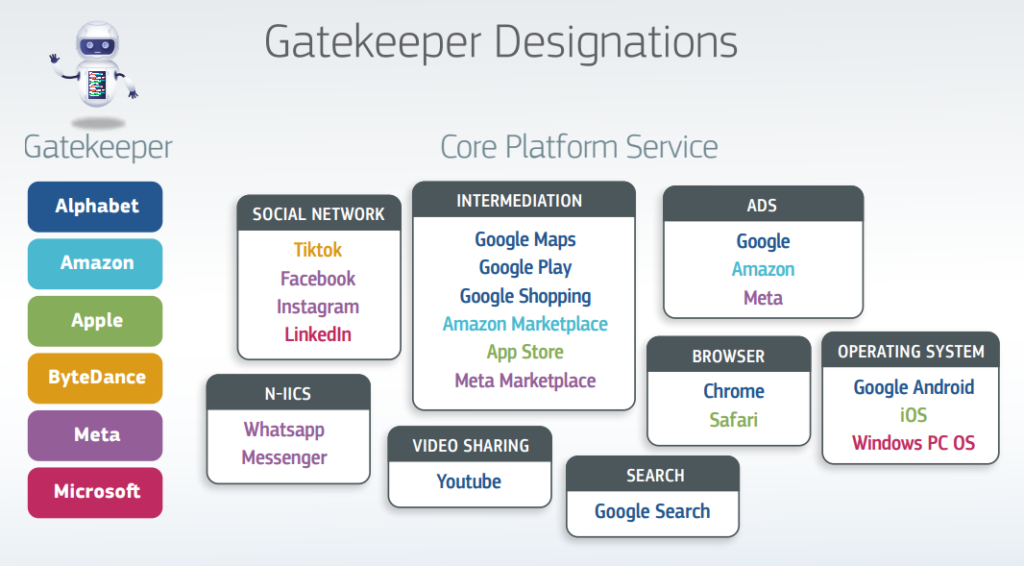
At the same time, the European Commission decided to exclude from the regulation three platform services belonging to Microsoft — the Bing search engine, the Edge browser and the Microsoft Advertising service — and one service belonging to Apple: iMessages.
By March 6, 2024, all the tech giants covered by the rules had to bring their operations fully into line with the obligations and prohibitions arising from the DMA.
Gatekeepers’ obligations and the effects of the new rules
The European Union is a pioneer in introducing such comprehensive regulation of internet giants. The new law aims to strike a balance between protecting user rights, competition and innovation, and the benefits of using digital services. Time will tell how effectively these rules are enforced and whether other regions of the world decide to take similar regulatory action. For now, using the tech giants’ services will look different inside the European Union than outside it. Nevertheless, gatekeepers’ compliance with the new rules will have a tangible impact on all digital market participants, including marketers’ work.
The DMA provides for a range of remedies that gatekeepers must implement in their operations to ensure fairness and openness in the digital sector. They take the form of obligations and prohibitions.
For non-compliance, tech giants face fines of up to 10% of their worldwide turnover, and for repeated infringements even up to 20% of that turnover.
The obligations include, among others:
1. Providing advertisers with information about their ads, including the price paid, the publisher’s remuneration (if the publisher consents) and all the metrics used to calculate the individual prices, fees and remuneration.
In light of this obligation, a gatekeeper should, as part of its services, provide advertisers daily and free of charge with information about ad prices and how much money the websites displaying the ads receive. The gatekeeper will have a similar obligation toward publishers.
Effect: If you pay Google for advertising, Google must tell you how much money the website displaying your ad receives. If the website doesn’t consent to disclosing its remuneration, Google must give you the average daily amount the site receives for displaying ads.
2. Giving advertisers and publishers access to the gatekeeper’s performance measurement tools and to the data they need to independently verify the ad inventory themselves.
Gatekeepers use complex algorithms to calculate metrics, which means business users cannot understand how costs are calculated and, ultimately, cannot determine whether a given service is profitable. The new rules mean gatekeepers will no longer be able to hide their measurement methods from advertisers and publishers, supplying them with nothing but a final, arbitrary result.
Effect: Google is obliged to give advertisers analytics tools such as Google Analytics, plus data on their ads’ performance (e.g. clicks, impressions, conversions, etc.), so they can independently verify their ads’ effectiveness themselves.
3. Giving business users access to the data provided or generated in the course of using the gatekeeper’s core platform services.
This is a business-user entitlement analogous to the right to information under the GDPR.
Effect: As an advertiser, you’ll be able to demand from Google, for example, full information about all your interactions and actions taken on the Google platform, and about what Google does with this data and how it processes it.
4. Ensuring end users have continuous access to the data they have provided, with the ability to port it.
This obligation gives users the ability to freely move their data between platforms of their choosing, and the gatekeeper must enable it. In other words, if you use a service offered by one platform (e.g. a social network), you have the right to move your data (such as posts, photos or contacts) to another platform (e.g. a competing social network) at no extra charge.
Effect: If you have a Gmail account and want to move your emails and attachments to another email provider, Google must provide the tools to do this free of charge and effectively. To meet the new requirements for transferring data to third-party apps or services, Google is testing a new API.
5. Allowing end users to easily uninstall apps on the gatekeeper’s operating system (those not essential to the system’s functioning), and allowing the installation of third-party apps (as long as they don’t threaten the security and integrity of the operating system).
This means gatekeepers will have to let users easily change the default settings in their operating systems (e.g. choose a different search engine as the default, instead of automatically steering users to the gatekeeper’s own). This will give users more freedom of choice and prevent monopolization of the search engine market.
Effect: Google is introducing additional choice screens on Android phones, making it easier for users to switch the default search engine or browser. These screens appear during device setup on Android phones, and in the Chrome app on desktops and iOS devices, from March 6, 2024.

6. Facilitating effective interoperability for other service and hardware providers with the gatekeeper’s software and hardware.
This means gatekeepers must allow business users and other service providers to communicate freely with the operating system, hardware features and software available in the gatekeeper’s services. The gatekeeper may, however, take measures to protect the integrity of its operating system, provided those measures are duly justified.
Effect: Apple, as a gatekeeper, must ensure that third-party products such as software or services can effectively interoperate with iPhone or iOS features, e.g. through compatibility with Siri (Apple’s virtual assistant).
The prohibitions include, among others:
1. Tracking end users’ activity — without their explicit consent — outside the gatekeeper’s core platform service for the purposes of personalized advertising.
This ban may reduce Google’s ability to deliver personalized content and ads (e.g. in remarketing). The same applies to the use of the Facebook pixel outside the social network itself.
Effect: This can potentially hurt the effectiveness of ad campaigns, since there’s a chance they won’t accurately reach the intended target groups.
2. Combining personal data from different platform services, and signing end users in to other services provided by the gatekeeper in order to combine that data.
This means gatekeepers won’t be able to use data from different services to build comprehensive user profiles or track users’ activity across their platform services (unless they obtain consent). Beyond privacy protection, this ban is also meant to curb the dominant position of gatekeepers, who have access to unimaginable amounts of data.
Effect: Google’s compliance with the ban can already be seen, e.g. in the messages received by users of Google’s various platform services — with Google itself stressing that if the services are not linked, some features involving data sharing between Google services will work in a limited way or be unavailable.

On seeing the message above, users get the option to keep their services linked, to pick some services to remain linked, or to unlink them entirely. This can be changed at any time in the account settings. You can read more about it in the Google help article.
3. Preventing business users from offering the same products or services to end users at prices or on terms different from those offered through the gatekeeper’s online intermediation services.
In other words, gatekeepers won’t be able to impose restrictions or requirements on other businesses that would prevent them from offering products or services on their own terms, outside the gatekeeper’s platform.
Effect: Google cannot prevent other companies from competing in the market by imposing price restrictions or platform terms that favor Google’s own services or those of its business partners.
4. Forcing end users to use specific services or tools within its platform.
This means gatekeepers have no exclusivity and cannot oblige users to use particular services or tools provided by the gatekeeper. Users must have freedom of choice and the ability to use alternative services or tools, where they exist, without being forced to use only those supplied by the gatekeeper.
Effect: Google won’t be able to require you to use the Google Pay payment system when you want to buy an app in the Google Play store but pay for it using another payment service.
5. Requiring business or end users to subscribe to or register with other core platform services as a condition of using the gatekeeper’s services.
Big tech companies cannot require business or end users to subscribe to or register with other core platform services in order to use their services. In other words, they can’t force users to subscribe to other services to gain access to the ones they offer.
Effect: Amazon cannot require you to subscribe to its online payment service (Amazon Pay) in order to use the shopping platform itself.
6. Using, for its own purposes, non-public data generated or provided by the business users it competes with.
From businesses’ perspective this is problematic, because they have to compete with a company that simultaneously provides the infrastructure and offers its own products or services through it. Now gatekeepers won’t be able to use confidential data obtained from their business users — in a non-public form or unavailable to other business users — to compete with them.
Effect: Amazon Marketplace cannot use sellers’ non-public business data to calibrate its own retail decisions.
7. Treating — in ranking and the related indexing and crawling — services and products offered by the gatekeeper more favorably than similar services or products offered by third parties.
This ban concerns favoring one’s own services and products in search and indexing results compared with similar services or products offered by other companies. In practice it means gatekeepers cannot manipulate search results so that their own services appear more attractive or rank higher than competitors’ services. All services must be treated equally and fairly. The DMA clarifies that the concept of ranking also covers cases where there is only one search result (e.g. virtual assistants).
Effect: Google has already announced a number of changes to the search results page in the European Union. New elements will appear containing a group of links to other comparison services, plus additional choice categories to help users refine their query.
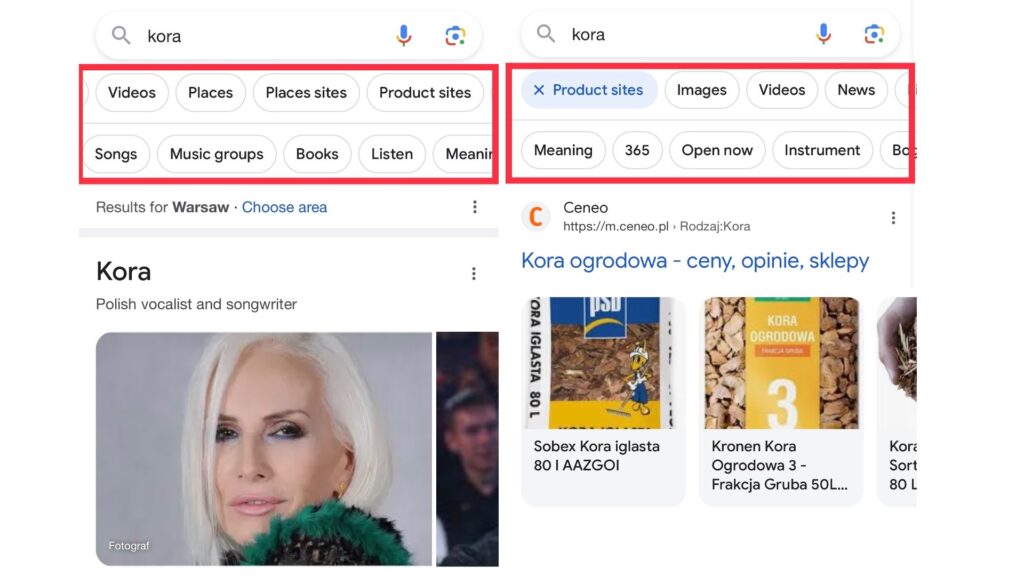
It’s possible that for categories such as hotels, a dedicated space will appear for comparison services and direct providers, showing more detailed individual results (including images or star ratings). These changes will also involve removing some features from the search results page, e.g. Google Flights (source: Google’s statement).
But what does the Digital Markets Act mean for marketers?
The largest tech companies, designated as gatekeepers, hold enormous power in online advertising. They control access to vast amounts of data (about users, advertisers, publishers) and dictate the key metrics for assessing performance — such as impressions, ad quality or user engagement — and they set the final price per conversion. This in turn shapes how marketers allocate budgets, which platforms they choose and how they plan campaigns, trying to achieve maximum reach and a satisfying return on investment.
Transparency of costs and metrics
Thanks to the new rules, marketers will have access to data that lets them better understand certain mechanisms (e.g. all the elements that influence winning ad auctions) and decide for themselves whether a given service or activity is worthwhile.
Restrictions on processing user data
Under the Digital Markets Act, user data from different platforms and services belonging to gatekeepers (or third-party services) may not be combined for profiling purposes (personalized ads) — unless the user consents. These restrictions may push advertisers to rethink their approach to profiling and audience segmentation, and to turn toward consent-based marketing or contextual advertising.
Consent mode
The new rules also bring challenges for marketers. One of them is the issue of user consent to tracking (data used e.g. in remarketing). Google announced new privacy requirements for all advertisers in the European Union, obliging them to pass consent parameters using a dedicated consent mode. Everything you need to know about consent mode is in this article.
Advertisers should be aware of the changes and adjust their strategies accordingly, to make full use of the new regulations’ potential and not be caught off guard by their effects. To avoid losing data and the ability to create personalized ads, Adequate can help you with implementing consent mode v2, required from March 2024.
Watching the shifting digital landscape, it’s clear the new regulations have caused quite a stir. Nevertheless, marketers — like other internet users — will undoubtedly benefit from most of the provisions of the DSA and DMA, which by design are meant to strengthen guarantees of transparency in content moderation, recommender systems and algorithms, and to protect the interests of smaller service providers and of users themselves. We can expect the new rules to bring visible results very quickly — and perhaps even that legislators across the ocean will in time follow the EU lawmaker’s example.
