
Google Ads advertisers commonly use keywords related to their own brand (brand campaigns). Opinions on whether it makes sense to use them most often point to the high effectiveness of these campaigns, the ability to customize the ad copy, and protection against competitors’ actions. Are such campaigns really the best-invested money?
Effectiveness
Google Ads campaigns on your own brand usually generate above-average ROI — both in last-click terms and in practically every other attribution model. High CTR, often penny-level cost per click and the best conversion rates add up to decent results.
Indeed, users who searched for our brand on Google convert with a much higher probability than those who landed on the site from a display ad or from an initial search for products from our (and not only our) range.
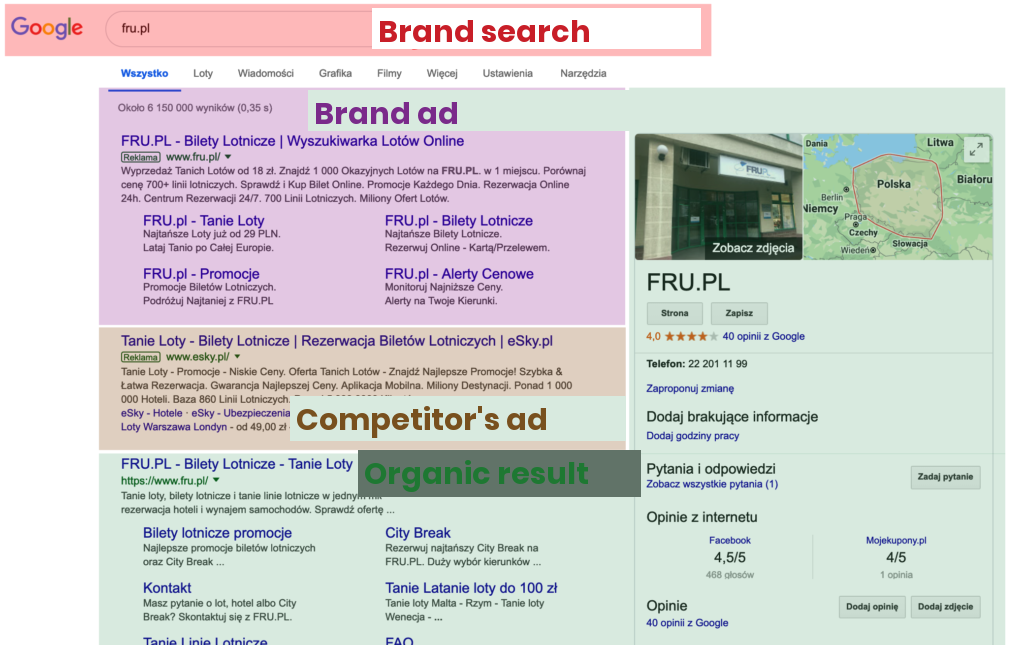
This high effectiveness is, however, something of an illusion. The brand search would not have happened were it not for the other marketing activities that made the user remember the brand. In reality, a brand campaign is not a touchpoint with the brand. It’s like a “goal scorer” whom the ball grazed after the actual scorer had taken the shot. Their contribution to this success is practically none.
The high effectiveness of a brand campaign is illusory.
Attributing a significant share of conversions to brand campaigns is a mistake. Traffic from these campaigns, just like traffic from organic searches for your own brand terms, should be treated like direct traffic and, as far as possible, not credited with any share of the conversion.
If we do credit it, we not only misjudge the profitability of brand campaigns, but above all we lower the value of generic and prospecting campaigns, which as a result may be under-invested.
To avoid this, we recommend that advertisers with a strong brand separate the brand campaign into a dedicated Google Ads account in order to obtain attribution that skips brand keywords. Such attribution allows the campaigns responsible for customer acquisition to achieve better results (see also our article on the Sprawny Marketing portal).
Does it affect ad quality and Quality Score?
You may come across the opinion that campaigns on your own brand have a beneficial effect on the Quality Score, and can therefore improve the effectiveness of other keywords in the account and lower the costs of the remaining campaigns. This is not true.
A brand campaign has no effect on the Quality Score of the remaining keywords
Yes, the Quality Score in such campaigns is usually very good and considerably exceeds the average of the other keywords. So if we create such a campaign, then — obviously — the average Quality Score in the account will improve (just as the average CPC will probably drop and the average CTR will rise).
Using brand keywords will not, however, have any effect on the performance of the remaining keywords — Google Ads will not lower the CPC for generic keywords just because we invested in brand keywords.
The Quality Score is determined individually for each keyword in combination with the ad and the landing page. The structure of Google Ads campaigns and ad accounts has no influence on it. Relationships between keywords, even if they are taken into account, can only serve to even out random statistical deviations for keywords with fewer searches or to predict their quality. There is no such thing as an account-level, campaign-level or ad-group-level Quality Score.
A brand campaign has no effect on the Quality Score or the CPC of the remaining keywords.
Protecting your brand against the competition
This seems to be the most important reason for running brand campaigns. Competitors can use our brand’s keywords to run their campaigns and — if they pay a sufficient bid — even appear first, above the links to our site.
Can such actions by the competition cause customer loss? To find out, it’s enough to do the same and launch a campaign on competitor brand keywords. Most likely it will turn out that such campaigns generate conversions. It’s not without reason that so many companies run them. If a campaign generates transactions for our competitor, these are purchases that were not made with us.
So are these customers we lost because of that ad? Not necessarily. Let’s take a look at the conversion paths. It often turns out that transactions with competitor keywords on the path are made by customers who had earlier searched for… our brand. This means that in many cases our offer “was in play” even before the user searched for our competitor.
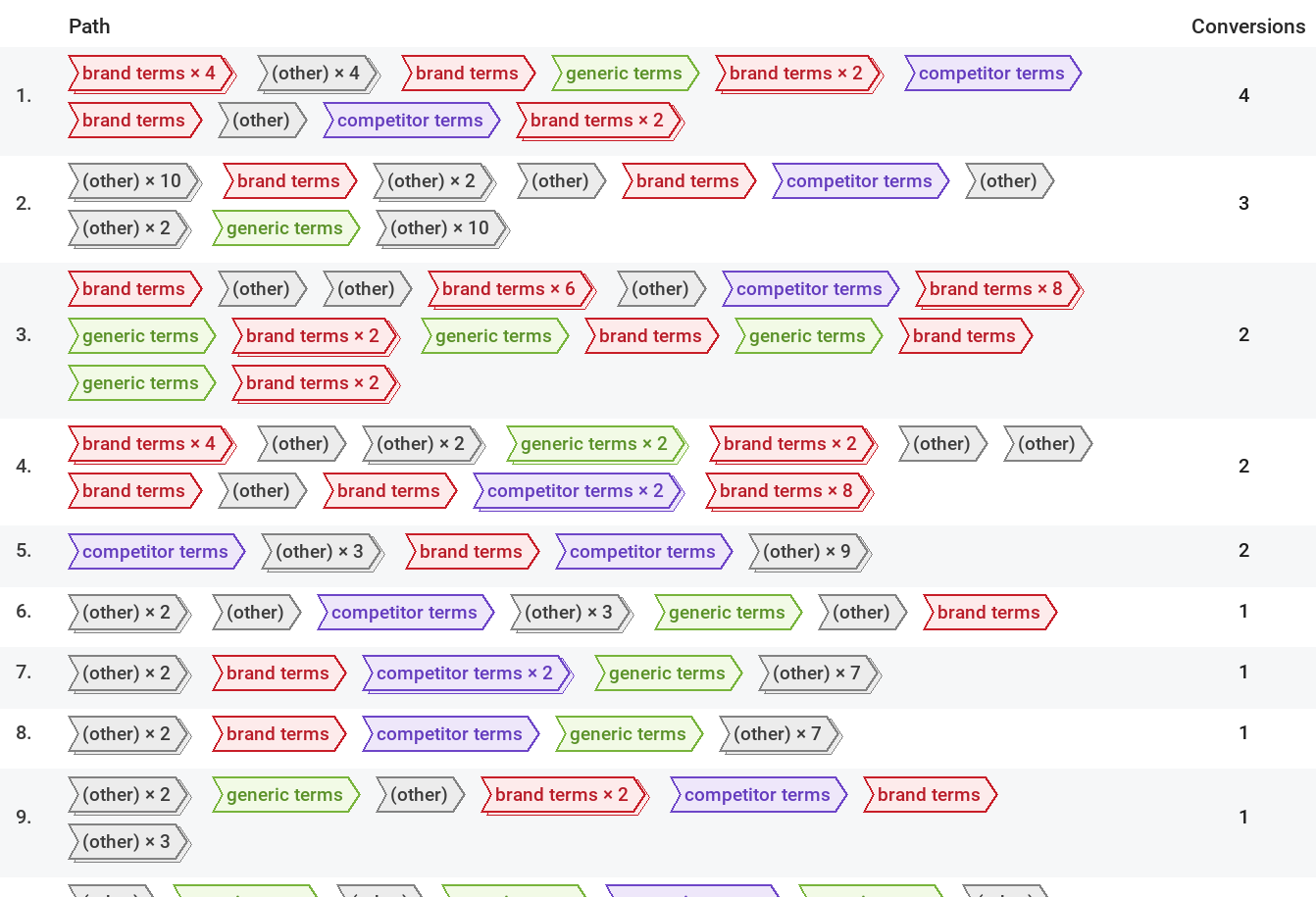
It’s natural that users browse various offers and may compare the proposals of several competing companies. They will try to reach them not only through generic searches (e.g. Egypt holidays), but also by searching for the brands of well-known companies (e.g. Rainbow, TUI, Itaka). In the end, they choose the offer that suits them better. The appearance of a competitor’s ad may or may not influence that decision.
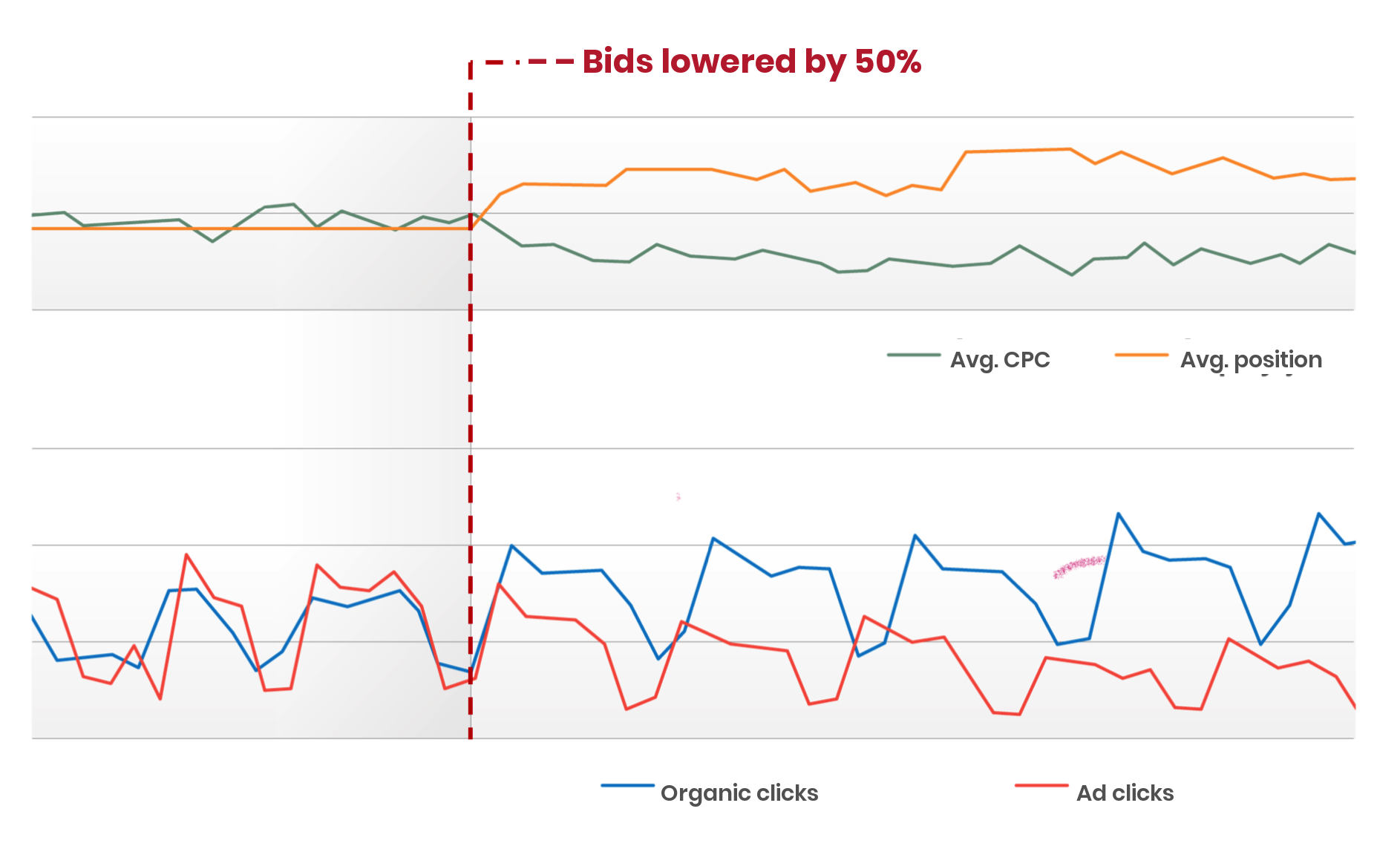
If we give up the brand campaign, does that mean users will go to the competitor’s site because it was first on the search results page for our brand? To some extent yes, but a large share of users will find the right link in the organic search results. And even if they click the competitor’s ad, they will most likely realize it’s not what they were looking for and repeat the search. The example below shows how, after limiting brand ads in Google Ads, the number of clicks from organic results for those terms increases.
Without a doubt, competitors’ ads appearing on searches for our brand are nothing pleasant (unless we treat it as a compliment). We should not expect these ads to have a positive impact on our sales. Some customers may learn about the competing offer this way, and some may even ultimately choose it. Even if they realize they clicked the competitor’s ad by accident and quickly return to the search engine, remarketing may in the future convince them to choose the competitor’s proposal.
A brand campaign can to some extent reduce the loss of customers caused by competitors’ ads
A Google Ads ad on your own brand will not, however, be one hundred percent protection against clicks on competitors’ ads — after all, the competition will not stop showing its ads. To what extent the presence of our ad there curbs this phenomenon we can only estimate very roughly, because there is no way to run an A/B test. What is certain is that conversions after clicking your own brand ad are only in a small part the ones we actually saved from being taken over by the competition.
So the question remains whether the spending on brand campaigns is worth it. If the customer value is high and clicks on brand ads cost pennies, there’s nothing to think about. Sometimes, however, the situation won’t be so clear-cut:
- It may happen that we have to pay high rates for clicks on our own brand. This will especially be the case for brands containing generic words, such as Domeny.pl, Hotele.pl or Kredyt Bank. Then it may turn out that defending the brand is too costly compared to the potential benefits.
- A similar problem affects services that users log into frequently, e.g. e-mail providers or dating sites. Even if the click is cheap, most clicks will come from already registered customers. Tip: remarketing lists for search ads (RLSA) can help in this situation.
- It’s worth noting that competitors’ ads don’t always appear for all brand-related queries — auction insights reports will be useful for analysis and monitoring. Where no other ads are showing, there is nothing to defend against.
- In brand advertising, the threat won’t only be our competitors. It can also be dishonest affiliates who will try to make easy money by showing ads leading to our site with a redirect through the affiliate program. Giving up brand advertising will make this practice easier for affiliates. See also the article on affiliate fraud.
Customizing the ad copy
Without a doubt, with an ad we have more control over its content and landing page than in organic results. This can matter if we currently want to promote a specific offer and direct as many users to it as possible. Brand campaigns make it possible to precisely direct users to promotion or sale pages.
In such situations an ad on your own brand can be useful. All the more so because it can be done faster and more simply than e.g. a promotional banner on the site’s home page.
A test of Google Ads on your own brand [Case Study]
We decided to run a test in which, using the methodology of a controlled conversion lift experiment, we would measure the impact of brand campaigns on the total number of conversions.
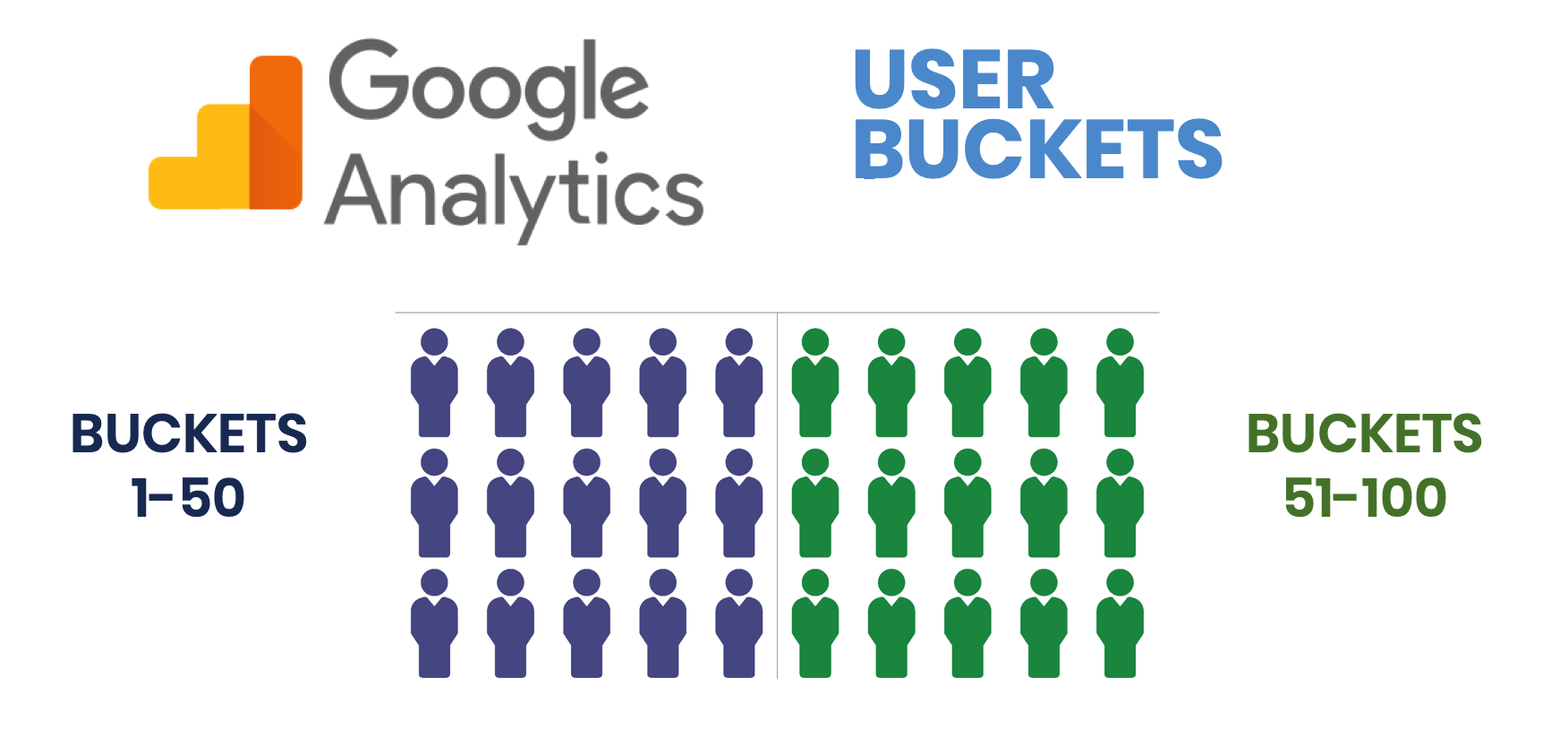
For this purpose we used user buckets from Google Analytics. User buckets randomly assign users numbers from 1…100:
On this basis we created two segments, a control group (1-50) and an experimental group (51-100), which we then used to create remarketing lists for search ads (RLSA), with which we blocked ads from being shown to a portion of returning users:
The User buckets feature was available in Universal Analytics. Until Analytics makes it available in subsequent versions, you can create a user-level custom dimension yourself, as was done in a similar test of remarketing ads.
Then, by reading the total number of conversions in these two segments in Google Analytics, we compared sales in the group where we blocked the ads with the control group. To avoid data sampling in Google Analytics, the data was pulled using the Supermetrics tool.
Experiment results
As a result of the test, we obtained a measurement in which the group that was shown the ads had fewer (!) conversions than the group that didn’t see the ads. We recorded:
- 1574 Google Ads (post-click) conversions for the brand ad in the observed segment;
- in Google Analytics, the segment of people who saw the ads had 213 fewer conversions than the segment where the ad was blocked.
This result, however, was not statistically significant, so we could not draw the (rather surprising) conclusion that advertising on your own brand is harmful.
Nevertheless, the power of the test allowed us to conclude that in the case of this client and this campaign, the Google Ads campaign on their own brand had no effect on conversion growth.
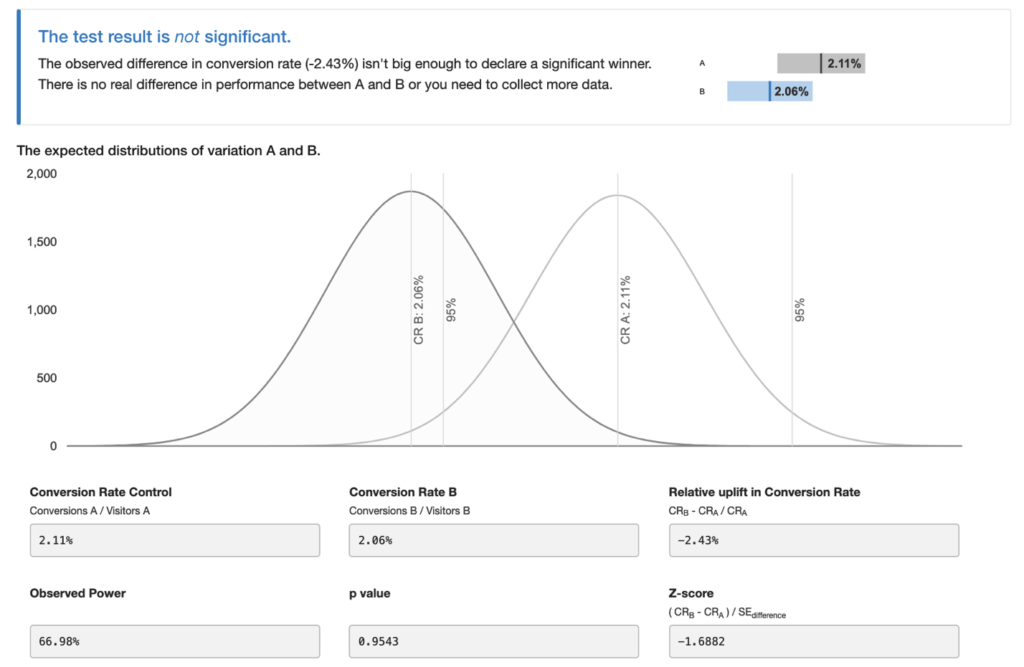
So in this case we found that running a campaign on our own brand had a negligible impact on sales. Set against the costs incurred for the campaign, a decision could be made to reduce the bids worth paying for these keywords, or even to stop the campaign entirely.
Certainly, no general conclusions can be drawn from this. Whether running such a campaign makes sense depends on many factors, including the level of competition in the search engine for a given keyword, which in the case discussed above was small.
Whether this will be the case in your specific situation can only be checked by running an experiment using the conversion lift method.
The geo lift test
Tests using remarketing lists, like the experiment described above, are limited to studying only returning users. What’s more, they rely on cookies, which — in the era of privacy protection, consent requirements and browser tracking restrictions — raises doubts about the accuracy of such measurement.
An alternative is a geo test, in which the control group is a specific geographic area. The inaccuracy resulting from people moving around and from location imprecision seems smaller than the one resulting from incomplete user tracking.
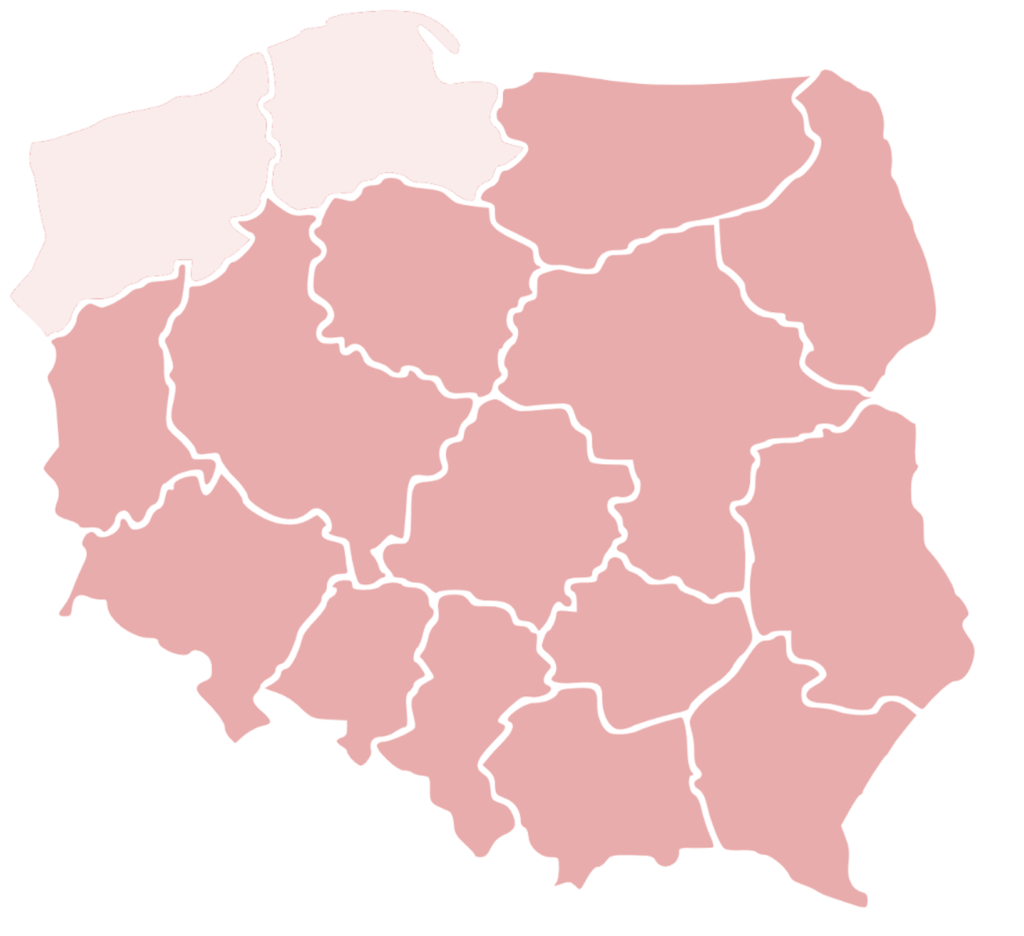
Analytics assesses a user’s location much less precisely than advertising systems, because Analytics relies solely on the IP address. That’s why the value being read was sales split by province based on the postal codes of orders.
The result of one of the tests we ran showed an incremental impact of the ads at the level of 40% of the value indicated by conversion tracking in the ads.
Here, however, the situation was somewhat different, because the advertiser was competing in the search engine with other sellers of their products (resellers) using competitive prices. It seems understandable that for buyers the fact of purchasing directly from the manufacturer is not necessarily important when they can buy a given product from another reputable seller at an attractive price.
See also the results of a similar GeoX test of own-brand keywords carried out by DAAG.
To use or not to use?
The decision on whether, with what bidding strategy and on which keywords to run brand campaigns should result from a thorough analysis of the benefits they bring, set against the costs incurred for them.
Certainly, measurement based on conversion tracking is not reliable in this case, and other methods must be used, based on experiments with a control group and scenario analysis.
