Focused on cutting PPC costs? You may be looking for profit in the wrong place.
Most optimisation efforts in eCommerce focus on optimising traffic acquisition costs and maximising the conversion rate by improving website functionality. Actions are also taken to increase conversion value by offering customers additional services and products (cross-selling).
One of the most often forgotten optimisation parameters is the price – the element that most strongly and directly affects conversion value.
What makes up profit?
The economic effect (profit) of e-commerce activities is the difference between sales revenue and the cost incurred to generate it. Mathematically, it can be presented as the difference between conversion revenue (P) and the cost of acquiring it (Cost/conv), multiplied by the number of conversions (Conv).

Converting conversions into clicks, we can write the profit formula as the difference between the value of a click and the cost of acquiring it, multiplied by the number of clicks:

Where the value of a click is calculated as the product of conversion revenue (P) and the conversion rate (CR):

We achieve the greatest profit by lowering CPC, maximising traffic (Clk) and the value of a click. We know, however, that maximising traffic volume contradicts lowering CPC. That is why the point of maximum profit is the perfect compromise between the volume of acquired traffic and its cost. We have devoted a series of articles to these issues on profit-driven optimisation. Nevertheless, the value of a click does not depend on the amount of traffic, so we can maximise it independently of marketing activities related to user acquisition.
How to maximise the value of a click?
According to the formula above, the value of a click consists of the conversion rate (CR) and transaction revenue (directly dependent on the offered price). These parameters are interdependent: the lower the price, the higher the probability of closing a transaction. By raising prices and increasing the earned margin (revenue), we lower the conversion rate.
By manipulating the price, we are therefore unable to simultaneously raise transaction revenue and increase the number of conversions. That is why here too, just like in optimising traffic volume and CPC, we should look for the perfect compromise: set a price level at which we obtain the highest revenue per user visiting our website (per click leading to the site).
What happens when we raise the price? Look at the charts below. As the price grows, the conversion rate falls. The value generated by each click (site visit) initially grows, and after reaching the maximum point it starts to fall, as an excessively high price discourages more and more customers.
Price elasticity generally decreases (takes on increasingly negative values). The point of maximum click value is where price elasticity equals -1.

Mathematical proof
At the point where revenue is greatest (the function’s maximum), its first derivative equals zero:

That is:
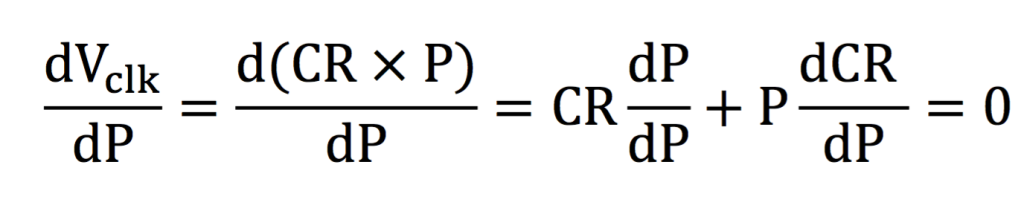
After transformation:
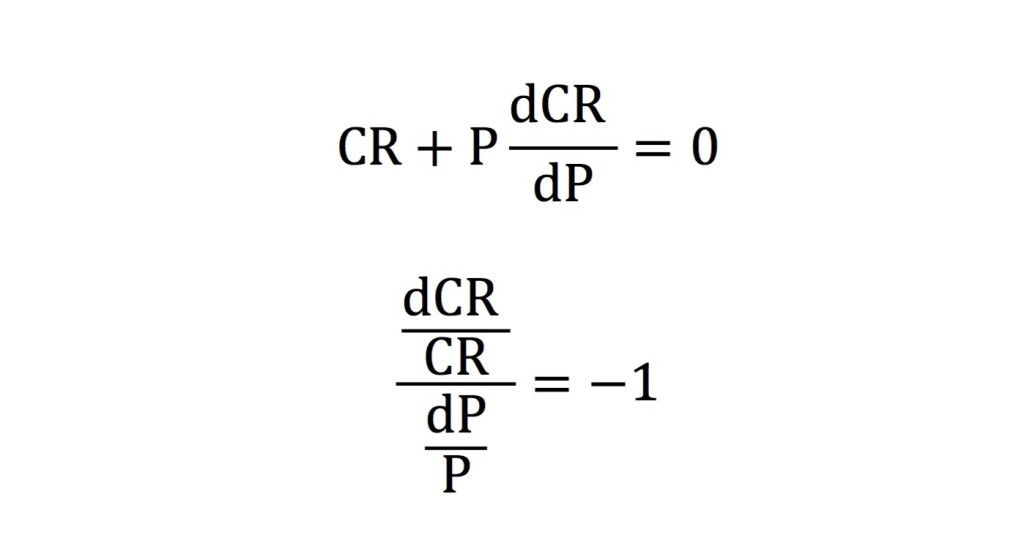
The left side of the equation is the relative change in conversion rate over the relative change in price, i.e. price elasticity. It turns out that click value is at its maximum when price elasticity equals -1.

How to optimise prices?
The formula is surprisingly simple: we test how a price change affects the conversion rate and look for the point where elasticity equals -1. If the price rises by 10% and the conversion rate falls by 20%, elasticity is -2. This means the price is already too high.
If a 10% price change also causes a 10% change in conversion rate, then elasticity at that point is -1 and we are close to the price that maximises the value of a click.
Price = Margin
Remember that by price we should here understand the earned margin, i.e. sales revenue minus cost of goods. For products sold in online stores, where the trade margin is relatively small, its increase causes a relatively small increase in the product’s price.
For example, if our margin is at 10%, increasing it by 20% will raise the product price by about 2%. What share of our customers will such a price increase discourage? For the customer such a price change may be unnoticeable, while for the store it will mean a significant increase in profits. The quoted numbers are of course just examples.
For this reason, a great many stores keep prices at too low a level, completely unnecessarily, limiting their profits and further expansion possibilities.
How to compensate for the drop in transaction volume?
As a result of raising the price to the optimal value, i.e. the one maximising user (click) value, we will most often cause a drop in the conversion rate and lose some of the most price-sensitive customers.
On the other hand, however, with the increase in click value, we can now pay more for traffic. Clicks we previously could not afford are now perfectly profitable for us. The acceptable conversion cost rises significantly, so we can buy more traffic. We can therefore profitably spend part of the money earned from the price increase on marketing, attract more traffic and, as a result, actually increase sales and raise profits even further!
Let’s see this in an example. An advertiser currently makes 50,000 zł profit on sales (situation A). They decide to increase ad spend, but the rise in cost per click is too steep and as a result their profits fall (situation B). It turns out the store cannot afford further expansion, so it returns to situation A.
After raising the product price (by just over 3%), the margin grows from 150 zł to 199 zł (situation C), and total profit rises to 79,100 zł. This happens even though the conversion rate falls, and the number of transactions falls too.
Now ad spend is increased again (situation D). Note that the campaign parameters change in the same way as in situation B. With the increased margin, however, it turns out that total profits grow, and the company achieves higher sales than before the price increase.

The risk of raising prices
Against the background of the above example, raising prices may seem a simple mechanism for increasing revenue. It is worth remembering, however, that the effect of losing customers due to price increases can occur gradually. Customers may realise that prices are higher with some delay. Market opinion and the negative word-of-mouth effect will not spread immediately.
That is why the influence of prices on customer behaviour should be analysed over a longer period, and prices should be raised gradually, verifying every now and then whether perhaps the time has come to lower them (when elasticity has fallen below -1).
Of course, it may turn out that prices are simply too high and a relatively small reduction will cause a multiple increase in conversions. Price optimisation is not about maximising the unit margin, nor about maximising the conversion rate, but about finding the sweet spot where the value of a click is at its highest.
