Websites offering online discount codes, also known as discount coupons (vouchers), are popping up like mushrooms, and e-commerce businesses are bombarded with partnership proposals.
Sales representatives argue that their offer is highly beneficial and guarantees a sales increase, and since billing is exclusively in the CPS model, i.e. per product sold, the client bears no advertising investment risk and can only gain from the partnership. Is that really so?
Potential benefits of coupons
Discount campaigns are one of the most popular, simplest and – as is commonly believed – proven promotion methods. Customers looking for low prices get lured by a bargain and buy, often spending more money than during “normal” shopping.
This is proven by customers storming shops in the first days of sales, and by the popularity of stores specialising in sales (outlets) or group buying, which is de facto an online clearance sale.
One method of offering discounts is discount coupons, handed to customers during promotional campaigns and also available in the form of coupon booklets, which for years have been a popular form of advertising aimed at hotel guests, whom nearby shops, restaurants and other service points want to attract.
Websites offering discount codes are precisely the transfer of the coupon booklet concept to the Internet. Such websites were created many years ago, and the most popular precursors include Coupons.com and RetailMeNot.
These websites have a large number of regular users and run online campaigns, including through their own mailing lists and social media activity. Thanks to this, they are able to generate a considerable number of customers.
Margin cannibalisation
Discounts and promotions usually bring an increase in sales. At the same time, by lowering the price, we reduce the margin earned on sales. The unit profit on a sale (i.e. sales revenue minus the costs of purchasing, storing and shipping the goods) will decrease.
If the drop in margin is not compensated by higher sales revenue, the discount campaign will result in a net loss. We will sell more units but earn less money.
In most cases, discount campaigns did increase sales – but decreased profit.
Most of the price-cut promotion effectiveness tests we have run showed that discounts have a negative impact on profits. Despite higher sales, the final effect was negative, especially after taking advertising costs into account – after all, discounted products also have to be advertised, just like products offered at regular prices.
It must be stressed, however, that our experience does not constitute a statistically significant sample, much less a universal answer to the question of whether discounts are worthwhile. The cases we tested concerned moderately priced products with moderate margins, applied by shops with an established position in a competitive market.
Discount promotions have a better chance of being profitable when the current margin is high, so a price cut will not cause a drastic drop in margin. They also make more sense when the customer’s Lifetime Value is relatively high compared to the profit on the current transaction, and the losses resulting from the promotion will be compensated by additional future benefits from acquiring a new customer. The competitive environment and seasonality will also matter.
Conversion cannibalisation by online discount codes
Discount codes available online carry an enormous risk of cannibalisation. It consists in discount coupons being used by customers who were determined to buy the product anyway, even without a discount.
How does it happen? A user buying goods in an online store, while completing the order they have finally decided on, notices the option to enter a discount code:

Intrigued by this option, the user decides to look for a discount code in the search engine, where they come across websites offering these codes:

Discount code providers eagerly exploit this, not only ranking for keywords related to popular brands, but even creating Google Ads campaigns.
It is worth noting that many users have already developed the habit of checking whether a discount happens to be available online, so hiding the discount code field in the standard cart is only a partial solution. The absence of assisting interactions will be no proof of the “cleanliness” of a discount code conversion.
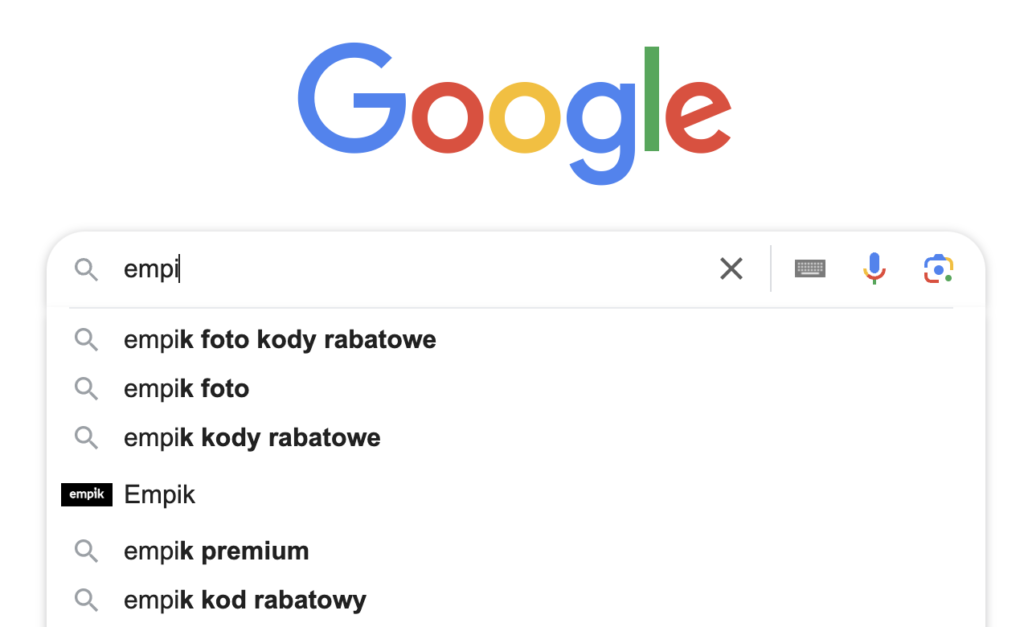
For those who have not thought of it yet, the search engine comes to the rescue, suggesting to users who are simply looking for a given store that such coupons are available:
So let’s not be surprised that conversion rates from coupon websites are higher than from direct visits. These are users “snatched” from the last stage of the conversion funnel who had already decided to buy the product.
Not only did we needlessly give away margin by granting a discount, we also paid a commission to a redundant middleman. Redundant, because even if the company policy is to grant a discount to practically everyone, anyone can put discount coupons on their own website and rank in Google for the right keywords. Supporting it with Google Ads is not much of a problem or cost either.
Coupon websites often “deliver” customers who would have bought our product anyway.
In the case of coupon websites that do not run intensive marketing campaigns, most of the sales will unfortunately most likely come from this practice. A disproportionately high conversion rate will indicate that the website focuses precisely on users who had already decided to buy but interrupted the purchase to look for an extra discount.
Therefore, even though we pay “only for sales”, in this case we are paying for our own customers, who most probably would have made the purchase anyway.
“But we don’t offer discounts…”
Discount codes are also used by “clever” affiliates with whom the store agrees on CPA billing (per sale, order, etc.) within an affiliate programme.
Even if such an affiliate really cannot offer a discount, a user looking for one will enter the affiliate’s website and go through an affiliate link that leaves a cookie on their computer entitling the affiliate to a commission on the sold goods. What’s more, it is likely that such an affiliate will be the last interaction before the conversion, which will supposedly prove that the customer was indeed delivered by the affiliate.
We once analysed the traffic on the website of a client who used the services of an affiliate network. In the traffic sources, our attention was drawn to referral sites that generated relatively many transactions, with a very high conversion rate, better even than direct traffic.
It took us some time to understand how a foreign website containing only a short company description was able to generate dozens of transactions a month. We knew the client was being cheated, but we didn’t know how.
To mask this practice, traffic can pass through several intermediate pages and several affiliate networks, so that the final entry to the website may come from a service that at first glance has nothing to do with discount codes.
Pay-per-sale is inherently suspicious
Above all, when we receive an advertising offer billed per sale, a “red light” should come on.
How is it possible that when we want to buy advertising, offers for ad space are quoted per impression or click, and ad space owners are extremely reluctant to discuss CPA billing (per completed action, e.g. sale, lead, registration) – and here suddenly someone insists on being paid that way? If a job candidate declared at the first interview that they don’t want a salary, only commission, wouldn’t that strike us as odd? Could it be that someone has found a brilliant way to identify, among the mass of users, those who will convert, and is now directing this extremely favourable and honest offer at us?
Discount coupons, including non-existent ones, are often a mechanism for extracting commissions in the CPA model.
There is some truth in that last sentence. The concept is indeed brilliant, and it consists in taking credit for customers who would have bought anyway. And although among traffic providers working in the CPA model we will certainly find some whose service has significant added value, we recommend approaching such offers with exceptional caution.
Remarketing
Another manipulation advertisers sometimes fall for is remarketing advertising.
Remarketing, sometimes sold under the name Programmatic or RTB, consists in reaching users who have already started the purchase process on the website, in order to bring them back to the site and lead to closing the transaction.
Remarketing is also often very effective when aimed at people who have completed a transaction – this customer no longer needs much convincing and there is a chance they will want to make further purchases. As a rule, running remarketing is advisable and it is a very effective way of increasing sales.
When deciding on performance-billed remarketing, advertisers usually set the CPA rate with reference to the conversion cost of remarketing or other advertising activities run in-house.
The problem is that if you run remarketing e.g. from your own Google Ads account, remarketing conversions are deduplicated with conversions coming from other Google Ads ads. If, after clicking a remarketing ad, the customer clicks another Google Ads ad (e.g. related to your brand) and converts, Google Ads will attribute the conversion not to remarketing, but to the last clicked ad. An external system tracking remarketing conversions will always attribute the conversion to itself as long as remarketing appears anywhere on the path. As a result, there will be far more of these conversions, and their conversion cost will be understated.

View-through conversions
As standard, CPA remuneration is paid when the conversion was preceded by an ad click. Sometimes, however, clients also agree to include ad impressions, even if the ad was not clicked but a conversion occurred after it was displayed.
Of course, display and video ads affect users even if they are not clicked, just like TV or press ads, which nobody clicks either. Impressions matter, and evaluating the effectiveness of e.g. YouTube video ads through the lens of clicks makes no sense at all.
Nevertheless, allowing view-through conversions to count in CPA billing without full control over where and how the ads are displayed is very unwise. Each of the spam techniques described above becomes easier to pull off. It is enough to run a high-reach campaign (e.g. 10%) to – statistically – gain the “right” to 10% of the transactions that took place on your website.
In fact, these ads can be displayed in small formats, often off-screen on pages overloaded with ads – so they will be practically invisible. The cost of such ads can be very low. CPA remarketing will also bring excellent “results” – here even more expensive ad placements will pay off; after all, it is enough for a user in the middle of shopping to see a CPA-billed ad just once and the commission will be due.
See also the article Ad fraud – scams in performance marketing
